Top 12 Best Commercial Fertilizer Spreader You Need Now
Handling fertilizer manually or with a cheap spreader often leads to clogging, uneven distribution, and wasted materials. A good best commercial fertilizer spreader can make a noticeable difference by ensuring consistent coverage and reducing the number of passes needed.
It’s common to see smaller, less durable machines struggle with heavier or granular fertilizers, which quickly compounds problems during large projects.
The best commercial fertilizer spreader typically features a sturdy frame made from corrosion-resistant steel or reinforced plastic to withstand frequent use outdoors. Capacity matters, with models often ranging from 200 to 500 pounds to avoid constant refills. Spreading width and adjustability are key for efficiency, units that cover 8 to 15 feet per pass save time.
Power sources vary, but reliable gas or electric options with controlled speed settings allow for more precise application. Easy cleaning is crucial too, as fertilizer residue can cause damage if left behind.
Need a Quick Check?
| Image | Product | Price |
|---|---|---|
Our Top Picks 1  | Buyers Products Spreader | Check Price |
Our Top Picks 2  | EarthWay 2150 Spreader | Check Price |
Our Top Picks 3  | Chapin TurfPro 100 | Check Price |
Our Selected Top 12 Commercial Fertilizer Spreader for Different Needs
This list includes a variety of commercial fertilizer spreaders designed for different work needs and capacities. Each review covers how the spreader performs, its ideal users, and highlights both strengths and potential drawbacks to help choose the right option.
1. Buyers Products 3039632R Walk-Behind Broadcast Spreader
Built with a heavy-duty commercial-grade drive system and a 100 lb hopper, this spreader suits landscaping crews and maintenance teams needing a reliable all-season tool. Its biggest strength lies in handling a variety of materials, from grass seed to ice melt, making it versatile throughout the year.
Setup is straightforward thanks to the simple flow lever that adjusts how much material is released. Day-to-day use keeps things controlled, with adjustable poly deflectors directing the spread pattern where needed and reducing waste or damage near garden beds and curbs.
It runs smoothly on its axle-driven spinner disc, making workload easier and more consistent.
Its main job of spreading materials up to 24 feet wide happens reliably due to the enclosed gearbox that protects the alloy gears from rust or weather problems. This tough build keeps it working through different seasons.
Most praise mention its dependable all-season versatility, but some reviews note that the spreader can feel a bit heavy to maneuver when fully loaded.
This spreader earns strong praise for its ability to switch easily between fertilizer, seed, and ice melt, working dependably across all seasons. The gearbox design keeps its moving parts well protected, though some find it challenging to push once the hopper is fully loaded, reflecting a trade-off between capacity and maneuverability.
Those maintaining large outdoor areas across different seasons will appreciate its versatility and solid construction. Users who need a lighter, more portable machine might look for smaller or differently designed models better suited for easier handling.
Pros
- Handles multiple materials year-round
- Adjustable spread pattern up to 24 feet
- Enclosed gearbox protects gears from weather
- Simple flow lever for precise control
Cons
- Feels heavy when hopper is full
- Limited to walk-behind operation
| Specification | Details |
|---|---|
| Product Dimensions | 40 x 26.5 x 32 inches |
| Item Weight | 1 pounds |
| Model Number | 3039632R |
| Hopper Capacity | 100 lb |
| Spread Pattern Width | Up to 24 feet |
2. EarthWay 2150 Commercial Broadcast Fertilizer Spreader
High flotation pneumatic tires stand out right away, built to tackle rough and uneven lawns with ease. Suited for commercial landscapers needing quick, smooth fertilizer application, it’s best known for gliding easily over tough terrain.
Setup is straightforward as you slide the clog-free grate in or out depending on your material flow needs. Adjusting the drop rate is simple and done directly on the spreader, while side-spread control helps create an even pattern with feathered edges.
Handling the unit feels sturdy thanks to its rustproof poly rims and 13-inch tires that roll well even on bumpy ground.
Spreading is consistent due to the 3-hole-drop system, which delivers a good balance of control and coverage. The enclosed gearbox promises durability and long service life.
The grate feature keeps clogging minimal, yet some mention that handling very fine material can still require occasional attention.
The grate system effectively keeps materials flowing smoothly, reducing blockages during spreading. Most users note the strong build of the enclosure but occasionally have to manage finer materials carefully.
Ideal for those working on uneven or rough lawns who want reliable, easy rolling spreader performance. Those needing more fine material precision or extra components might consider other options.
Pros
- High flotation 13 inch pneumatic stud tires
- Clog-free grate slides in and out easily
- Adjustable drop rate with side-spread control
- Fully enclosed gearbox for durability
Cons
- Handling very fine material may need extra attention
- Only includes the item itself, no attachments
| Specification | Details |
|---|---|
| Brand | EarthWay |
| Model Number | 2150 |
| Number of Items | 1 |
| Part Number | 2150 |
| Warranty Description | 5-Year Limited Warranty |
3. CHAPIN 89400C TurfPro 100 Lb Lawn Spreader
Choosing a fertilizer spreader that handles large loads without frequent refills is essential for commercial use. The CHAPIN 89400C TurfPro offers a 100 lb capacity, making it ideal for contractors and serious gardeners.
Its main strength lies in its durable build suited to various materials and weather conditions.
Setup requires attaching and adjusting the slide lever to match the particle size of your fertilizer or seed. Day-to-day use flows smoothly thanks to the directional spread pattern control, allowing you to target specific areas without waste.
The green poly hopper resists weather, and the zinc-plated agitator helps prevent clumps, keeping application consistent.
Performance stands out with its effective distribution of fertilizer, pest control, and seeds, covering wide areas evenly. Built solidly enough to handle commercial tasks, it weighs 32.2 pounds, so it feels sturdy but manageable.
The top praise revolves around its reliable spreading action, while the most frequent complaint is the heaviness during extended use.
The strongest praise points to the spreader’s ability to apply materials evenly without clogging, thanks to the zinc-plated agitator and adjustable gate. Many users note the heaviness, which can make long periods of pushing tiring. It performs well but demands some physical effort.
Those needing to cover large commercial spaces quickly will find the capacity and durability well suited to their tasks. Users with smaller or more frequent jobs might prefer a lighter, more compact model to reduce fatigue.
Pros
- Large 100 lb hopper capacity
- Weather-resistant material
- Directional spread pattern control
- Zinc-plated agitator breaks up clumps
Cons
- Relatively heavy at 32.2 pounds
- Can feel cumbersome on long jobs
| Specification | Details |
|---|---|
| Product Dimensions | 47 x 24 x 35 inches |
| Item Weight | 32.2 pounds |
| Capacity | 100 lb |
| Material | Green poly hopper, zinc-plated agitator |
| Model Number | 89400C |
| Manufacturer | Chapin |
4. EarthWay 2030P-Plus Commercial Walk-Behind Broadcast Spreader

Spreading fertilizer evenly over a large lawn or commercial turf can be a time-consuming task, especially when hopper refills interrupt your flow. Designed for both commercial and residential users, this spreader’s standout feature is its large 65-pound hopper, letting you cover more ground without constant stops for refilling.
Setting the spreader up is straightforward, with the intuitive adjustment directly on the machine to control how much material drops out. The 10-inch pneumatic tires roll smoothly across turf without causing damage.
Side Spread Control helps keep fertilizer away from flowerbeds and sidewalks, preventing waste and mess. Maintenance focuses mainly on cleaning after use, with rustproof parts reducing the usual wear concerns.
Covering your lawn evenly is where this spreader excels. The patented 3-hole-drop system works with a side-spread feature to keep the edges feathered for more precise application.
Construction holds up well thanks to rustproof materials, especially on rims and the large hopper. Praised for its consistency in spreading, the occasional complaint centers on the 93-day warranty, which some find limited for long-term commercial use.
The spreader provides a consistent, even application thanks to its 3-hole-drop system and side-spread control, which many find helpful for protecting turf edges. Rustproof materials, including the large hopper and tire rims, contribute to its durability during regular use. However, the 93-day warranty leaves some concerned about long-term commercial reliability.
Anyone needing to cover large areas efficiently with controlled spreading will appreciate this model’s design and features. Users wanting extended warranty support or those handling exceptionally heavy-duty commercial use may want to explore options offering longer coverage or more specialized durability guarantees.
Pros
- Large 65-pound rustproof hopper reduces refill stops
- Accurate spread with 3-hole-drop and side-spread control
- Pneumatic 10-inch tires protect turf during use
- Adjustable drop rate for precise material application
Cons
- Warranty period limited to 93 days
- Some users may want longer-term durability assurance
| Specification | Details |
|---|---|
| Model Number | 2030P-Plus |
| Hopper Capacity | 65 pounds (29.48 kg) |
| Tire Size | 10 inch pneumatic |
| Brand | EarthWay |
| Included Components | Side Spread Control, Even Spread, Pneumatic Tires |
| Warranty Description | 93 Day Warranty |
5. CHAPIN 88800B SaltPro Contractor Salt Spreader
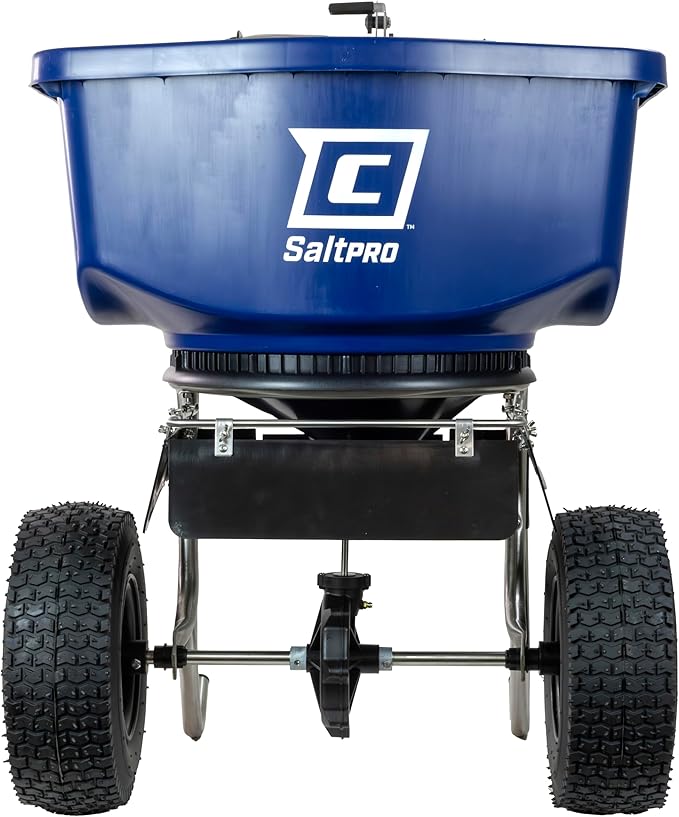
Holding up to 100 pounds of compatible ice melt, this spreader suits large winter jobs without constant refilling. Its ability to carry more material between refills makes it ideal for contractors or anyone managing significant icy areas.
Setting up the spreader is straightforward thanks to the adjustable gate opening and solid linkage controlling how much material flows out. The side and rear baffles guide the spread pattern and keep material from spraying back toward you.
The spiked auger inside breaks up any clumps, helping to keep the ice melt flowing smoothly during use.
The spreader performs well at evenly distributing pelletized ice melt on big surfaces, with a solid build that resists weather and rust. It’s praised for durability and material control.
Common feedback points to its limitation with materials like sand or lime, which it’s not designed to handle properly.
The spreader is highly praised for its durable design and smooth material distribution using the spiked auger and adjustable gate. The most frequent downside is its inability to handle sand or lime, limiting its versatility to pelletized ice melt only.
This product fits well for anyone who needs to cover large icy surfaces efficiently and wants to avoid constant refilling. Those requiring spreaders for sand, lime, or other materials should consider alternatives better suited to those substances.
Pros
- Large 100 lb hopper reduces refills
- Adjustable gate controls material flow
- Spiked auger prevents blockages
- Weather-resistant and rust-resistant construction
Cons
- Not suitable for sand or lime products
- Relatively heavy at nearly 39 pounds
| Specification | Details |
|---|---|
| Hopper Capacity | 100 lb poly hopper |
| Dimensions | 44 x 24 x 35 inches |
| Item Weight | 38.7 pounds |
| Material Compatibility | Small or pelletized ice melt only |
| Model Number | 88800B |
6. Agri-Fab Pull Behind Broadcast Spreader 130 Lb Capacity
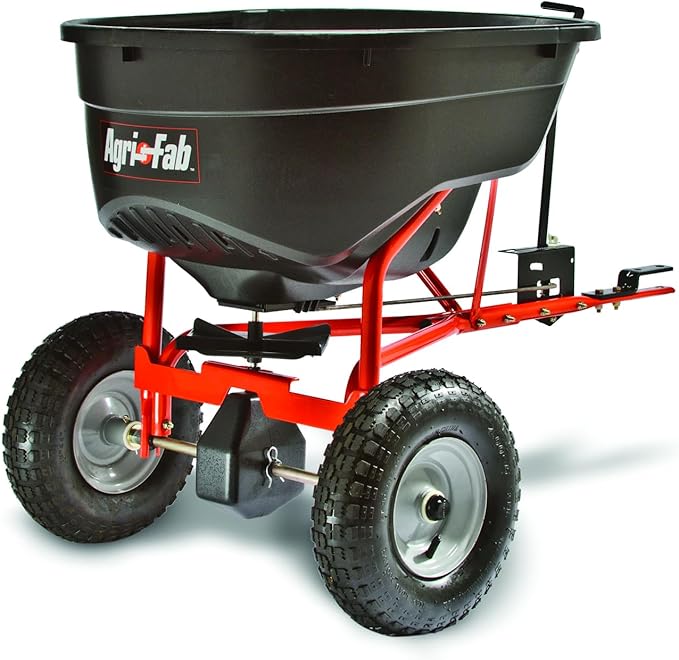
Ideal for large property managers needing wide coverage, this pull-behind broadcast spreader handles big jobs with a 130 lb hopper. Its main strength lies in covering up to 1/2 an acre with fewer refills, which saves time on larger lawn projects.
Setup involves attaching the universal hitch to most riding lawn mowers or tractors, including well-known brands like Craftsman and Husqvarna. Day-to-day use reveals the convenience of a wide 10 to 12 ft spread width that cuts down on passes. The hopper holds enough seed or fertilizer so you won’t be stopping often, making it easy to tackle various materials like grass seed, salt, or fertilizer throughout the year.
Consistent spreading is a strong point, giving more even coverage across large lawns. The build is sturdy for a product meant to be towed behind tractors. The most praised feature is how it handles large loads with steady distribution.
A common complaint is that, while capacity is high, the spreader can be heavy to maneuver when empty.
The biggest praise revolves around the 130 lb hopper’s ability to cover large areas with fewer stops, making it efficient for wide lawns. The most frequent downside is that the spreader feels heavy and less easy to maneuver when it’s not loaded. Cleaning is also noted as a bit of a chore compared to lighter models.
Those managing large properties who need to consistently distribute fertilizer or seed in bulk will appreciate the hopper size and wide spread range. People looking for something lighter or more compact might want to consider smaller or hand-pushed alternatives for easier handling and storage.
Pros
- Large hopper covers up to 1/2 acre per fill
- Wide spread width reduces passes
- Universal hitch fits many tractor brands
- Versatile for all-season use
Cons
- Heavier to pull when empty
- May require effort to clean
| Specification | Details |
|---|---|
| Hopper Capacity | 130 lb |
| Spread Width | 10 ft to 12 ft |
| Compatibility | Universal hitch fits most riding mowers and tractors |
| Recommended Uses | Distributing seeds, fertilizer |
| Warranty | 3 year limited warranty |
7. CHAPIN 88200A SaltPro 80 Lb Salt Spreader

Designed for spreading salt or ice melt on driveways and sidewalks, this manual spreader fits well with homeowners or small commercial users tackling medium to large outdoor areas. Its standout feature is the precise control offered by 30 gate settings and adjustable baffles to target the spread exactly where it’s needed.
Getting started means filling the 80-pound capacity hopper, which holds enough material to avoid constant refills. The plastic spiked auger supports steady flow by breaking up clumps, though it works best with pelletized ice melt rather than rock salt or sand mixes. Adjusting the gates takes effect immediately, and the included cover protects the contents when weather turns bad.
It performs solidly for spreading fine or pelletized material with good accuracy thanks to the directional baffles. The hopper and frame resist rust and weather well over multiple uses. Most users appreciate the adjustable flow, while some note limited compatibility with rock salt and heavier materials as the key downside.
The spreader handles pelletized ice melt with reliable material flow and good coverage control, but it struggles with rock salt and sand-based products. Most find the rust-resistant build and adjustable gates useful, though the need for manual pushing can be tiring during larger jobs.
Those needing a spreader for pelletized products over larger areas will find it well-suited. Anyone wanting to spread heavier or mixed materials frequently might prefer a model with power assistance or more durable auger options.
Pros
- Thirty gate settings for precise coverage
- Adjustable front and side baffles
- Plastic spiked auger reduces clumping
- Rust-resistant 80 lb poly hopper
Cons
- Not suitable for rock salt or sand mixes
- Manual power requires physical effort
| Specification | Details |
|---|---|
| Power Source | manual |
| Wheel Size | 12 inches |
| Hopper Capacity | 80 lb |
| Material | Poly, rust-resistant |
8. Scotts Turf Builder EdgeGuard DLX Broadcast Spreader

Scotts Turf Builder EdgeGuard DLX Broadcast Spreader excels at delivering even coverage for large lawns up to 15,000 sq. ft. Ideal for homeowners and landscapers who need a reliable, pre-calibrated spreader that works well year-round, including spreading ice melt during winter.
Its EdgeGuard technology minimizes mess along edges and hard surfaces.
Setup takes no time since it comes ready to use without assembly. The hopper with an agitator ensures materials flow smoothly whether you’re spreading fertilizer, grass seed, or ice melt.
Adjustments aren’t necessary for most tasks, making it simple to roll across your lawn while maintaining consistent coverage thanks to the EdgeGuard side shield.
The spreader offers solid performance in distributing lawn products evenly. It’s built to last with durable components and holds a good amount of material for sizeable jobs. Many reviews highlight how well it prevents product from scattering onto sidewalks or driveways, though some find the weight a bit heavy when fully loaded.
It handles grass seed and ice melt equally well.
Many users appreciate how the EdgeGuard system keeps lawn products off sidewalks and landscaping. Consistent spread rate with no assembly needed also gets praised. The clearest drawback mentioned is the weight when filled, which makes it a bit harder to push across very large areas.
Those who want a ready-to-go spreader suited for multiple materials and moderate lawn sizes will like this model. People with extremely large commercial lawns or those preferring lighter-duty tools might want to explore other spreaders better suited for heavy workloads or easier handling.
Pros
- Pre-calibrated and no assembly needed
- Hopper and agitator for smooth product flow
- EdgeGuard keeps material off driveways
- Multi-use for fertilizer, seed, ice melt
Cons
- Can feel heavy when fully loaded
- Mostly plastic parts may limit long-term durability
| Specification | Details |
|---|---|
| Brand Name | Scotts |
| Model Number | 76232 |
| Capacity | Up to 15,000 sq. ft. coverage |
| Included Components | Scotts – 76232 |
| Set Name | Scotts Turf Builder DLX Broadcast Spreader Set |
9. Agri-Fab 45-0614 Push Lawn & Garden Broadcast Spreader
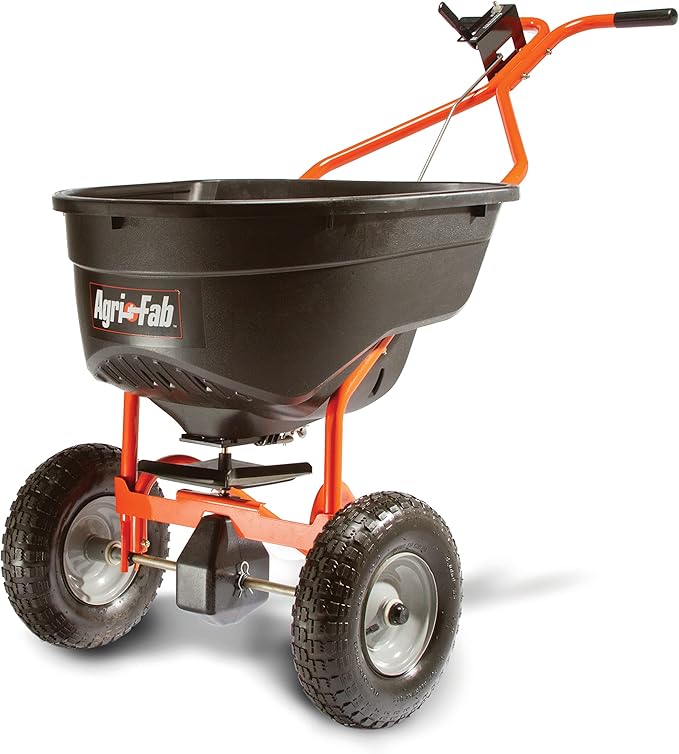
Handling a large spread area without constant refilling makes yard work much easier, especially for medium-sized properties. Designed with a 130-pound hopper and a 10-12 foot spread width, it fits well for anyone covering up to half an acre.
The biggest strength lies in its simple push operation and reliable material quality, which feels sturdy in hand.
Setting up involves filling the big hopper, which holds 130 pounds, enough for 25,000 square feet, so you don’t have to pause often. The push mechanism uses direct rod control, making it straightforward to adjust spread rate on the go.
Big 13 by 4 pneumatic tires roll smoothly over uneven ground, while weighing just 22 pounds makes it manageable without feeling heavy to push around.
The spreader covers fertilizer evenly over a 10 to 12-foot path, handling commercial fertilizer well without leaving large gaps. Built solidly in the USA, its frame and tires show durability that lasts through several seasons. The most common gripe is from users wishing it could handle larger jobs without refilling, while many praise its smooth operation and consistent spread pattern.
The spreader’s main benefit lies in its roomy hopper and steady distribution, making fertilizer application feel smooth and effective. It’s noted that the size limits how much area can be covered before refilling, which is a point some users find inconvenient for larger commercial jobs.
Gardeners and small business operators working on half-acre plots or less will appreciate its design. Larger commercial landscapers should look for options with bigger capacity or motorized features to reduce manual labor over extensive properties.
Pros
- Large 130 lb hopper reduces refilling trips
- Wide 10-12 ft spreading coverage per pass
- Durable 13″ pneumatic tires handle rough terrain
- Simple direct rod control for easy adjustments
Cons
- Not suited for areas larger than 1/2 acre
- No motorized assistance; must be pushed manually
| Specification | Details |
|---|---|
| Hopper Capacity | 130 lbs.; 1/2 acre (25,000 sq. ft.) |
| Spread Width | 10-12 ft. |
| Wheels | 13″ x 4″ pneumatic tires |
| Operation | Easy to use direct rod control |
| Product Dimensions | 48 x 27.2 x 33.7 inches |
| Item Weight | 22 pounds |
10. EarthWay 2050P Broadcast Spreader with Poly Hopper

Ideal for large lawns and professional use, the EarthWay 2050P Broadcast Spreader stands out with its 80lb capacity. It’s designed to handle extensive lawn care with precision, making it a solid choice for those wanting a reliable spreader for grass seed and fertilizer over big areas.
Setup is straightforward since it comes pre-assembled. The pneumatic tires make maneuvering smooth, even on uneven ground.
Adjusting the side spread control lets you fine-tune where the material goes, so there’s less waste. The rustproof poly hopper means no worries about corrosion after use, and daily operation feels sturdy and stable.
Performance matches the hefty capacity, covering large areas without constant refills. The enclosed gearbox adds to its long life by protecting the mechanism.
Users appreciate how well the spreader controls application. The main drawback mentioned is its weight, which can make it a bit tough to push over very rough terrain.
Many users value the precise control and solid durability of the spreader, especially its rustproof hopper and enclosed gearbox. The main challenge is its weight, which some find demanding when working on uneven ground.
People managing large, flat lawns or commercial properties will appreciate this spreader’s capacity and build. It may not be the best for those needing a lighter option or working mostly on rugged or steep areas.
Pros
- Large 80lb capacity for big jobs
- Rustproof poly hopper resists corrosion
- Side spread control reduces waste
- Durable enclosed gearbox extends lifespan
Cons
- Heavier weight can be tough to push
- Not ideal for very rough or steep terrain
| Specification | Details |
|---|---|
| Brand | EarthWay |
| Model Number | 617407731798 |
| Unit Count | 1 Count |
| Item Type Name | EarthWay 2050P 80 LB Deluxe Heavy-Duty Walk-Behind Commercial Broadcast Spreader Pre-Assembled with Pneumatic Tires, Built-in Side Spread Control |
| Part Number | 2050P |
| Manufacturer | EarthWay Products Inc |
11. Lesco High Wheel Fertilizer Spreader 101186

Constructed with durable materials and a practical design, the Lesco High Wheel Fertilizer Spreader 101186 suits commercial landscapers or contractors handling medium-sized fertilizer jobs. Its standout feature is the large 80-pound hopper capacity, allowing significant coverage without constant refills.
Some assembly is involved but instructions make it straightforward. The manual deflector kit helps control distribution direction, essential for precise application. The enclosed gearbox with a 5:1 gear ratio ensures smooth and consistent spreading, while the high wheels make navigating uneven terrain easier during daily tasks.
Spreading fertilizer evenly is reliable thanks to its solid build and functional gearbox. The hopper’s size reduces frequent stops, though some mention that assembly can be a bit tricky. The frame and components hold up well over time, with the main compliment being consistent performance and the most common complaint focusing on assembly effort.
Lesco High Wheel Fertilizer Spreader 101186 handles up to 80 pounds of fertilizer and features a manual deflector kit for easy control. Its enclosed gearbox with a 5:1 gear ratio provides reliable spreading, but some assembly is necessary. Many find the setup instructions clear, though time-consuming, and the high wheel design makes covering larger areas manageable.
People who need a durable spreader for commercial use and prefer manual gear control will find this model useful. Those managing smaller or uneven lawn areas might want to explore lighter or walk-behind options as this unit is best suited for larger, more uniform surfaces. Assembly time should be considered before purchase.
Pros
- Large 80-pound hopper capacity
- Manual deflector for precise spreading
- Durable enclosed gearbox
- Instructions included for assembly
Cons
- Assembly can be challenging
- Not fully pre-assembled out of the box
| Specification | Details |
|---|---|
| Hopper Capacity | 80 lbs. |
| Gear Ratio | 5:1 |
| Includes | Manual Deflector Kit |
| Assembly | Some assembly required; Instructions included |
| Model Number | 101186 |
12. CHAPIN 8400C Professional SureSpread Turf Spreader

Designed for serious lawn care, the red CHAPIN 8400C turf spreader stands out with its large 100-pound hopper. Ideal for anyone handling commercial or large residential fertilizer jobs, its biggest appeal is how it combines sturdy construction with easy maneuverability.
You get a tool built to last and move well over uneven ground.
Setup means just getting it ready to roll, since the single-piece poly hopper is weather and rust resistant right out of the box. The T-shaped handle with rubber grips makes pushing comfortable, even wearing gloves.
The enclosed gearbox reduces maintenance, and the included rain cover and hopper grate help keep the fertilizer dry and manageable during your work.
Performance shines with consistent spreading thanks to the SureSpread system housed inside the weather-protected gearbox. The stainless steel frame adds extra durability to the whole setup.
Users often praise how sturdy and reliable it feels, though some note it can be a bit heavy when fully loaded and awkward to maneuver in tight spaces.
The spreader is praised for its strong construction and weather resistance, making it dependable for heavy use over time. A common drawback is its weight, which can make handling harder during long jobs or around tight spots.
Anyone working on large turf areas will appreciate the capacity and durability, while those needing lightweight or highly compact equipment might want to consider other options.
Pros
- Large capacity hopper holds 100 pounds
- Weather and rust-resistant poly hopper
- Enclosed gearbox protects moving parts
- Comfortable push handle with rubber grips
Cons
- Can be heavy when hopper is full
- Maneuvering tight spaces can be challenging
| Specification | Details |
|---|---|
| Brand Name | CHAPIN |
| Model Number | 8400C |
| 100-Pound Capacity Hopper | Yes |
| Frame Material | Stainless Steel |
| Handle Style | T-shaped with rubber grips |
Best Commercial Fertilizer Spreaders Comparison Table
| Product | Capacity | Weight | Power Source | Warranty |
|---|---|---|---|---|
| Buyers Products Spreader | – | 1 pound | – | – |
| EarthWay 2150 Spreader | – | – | – | 5-Year Limited Warranty |
| Chapin TurfPro 100 | – | 32.2 pounds | – | – |
| EarthWay 2030P-Plus | 65 LB (29 KG) | – | Walk-Behind Manual | – |
| Chapin SaltPro Contractor | – | 38.7 pounds | – | – |
| Agri-Fab Pull Behind 130 | – | – | – | 3 year limited warranty |
| Chapin SaltPro 80 | – | – | Manual | – |
| Scotts EdgeGuard DLX | – | – | – | – |
| Agri-Fab 45-0614 | – | 22 pounds | – | – |
| EarthWay 2050P Poly | 80 LB (36 KG) | – | Walk-Behind Manual | – |
| Lesco High Wheel | – | – | Manual | – |
| Chapin SureSpread 8400C | 100-Pound Capacity | – | – | – |
- Capacity–
- Weight1 pound
- Power Source–
- Warranty–
- Capacity–
- Weight–
- Power Source–
- Warranty5-Year Limited Warranty
- Capacity–
- Weight32.2 pounds
- Power Source–
- Warranty–
- Capacity65 LB (29 KG)
- Weight–
- Power SourceWalk-Behind Manual
- Warranty–
- Capacity–
- Weight38.7 pounds
- Power Source–
- Warranty–
- Capacity–
- Weight–
- Power Source–
- Warranty3 year limited warranty
- Capacity–
- Weight–
- Power SourceManual
- Warranty–
- Capacity–
- Weight–
- Power Source–
- Warranty–
- Capacity–
- Weight22 pounds
- Power Source–
- Warranty–
- Capacity80 LB (36 KG)
- Weight–
- Power SourceWalk-Behind Manual
- Warranty–
- Capacity–
- Weight–
- Power SourceManual
- Warranty–
- Capacity100-Pound Capacity
- Weight–
- Power Source–
- Warranty–
How to Choose the Right Commercial Fertilizer Spreader
Choosing a commercial fertilizer spreader involves considering factors like capacity, durability, and ease of use to ensure it matches the size and type of your application. Getting these right helps prevent uneven spreading and equipment breakdowns, ultimately saving money and reducing hassle.
Spreading Capacity and Coverage
Covering a large lawn or commercial field demands a hopper that can hold enough material to prevent constant refilling. For typical commercial use, a hopper capacity between 40 to 80 pounds strikes a good balance, allowing longer operation before topping up.
The spreading width also plays a key role; models with adjustable spread widths from about 10 to 20 feet let you tailor coverage to different job sizes and fertilizer types.
Compatibility with various fertilizer granules is often overlooked. Fertilizers can range from fine powders to coarse pellets, and the spreader’s design needs to handle these without clogging or uneven distribution. Look for adjustable spread patterns and flow rate controls that accommodate different granule sizes and weights, ensuring the material is evenly spread across the target area without waste or missed spots.
Durability and Build Quality
Frames made from steel generally hold up better over time compared to plastic, especially under rough commercial use. Plastic hoppers save weight and resist rust, but they can crack under heavy loads or impact. A steel frame paired with a durable plastic or metal hopper often offers a good mix of strength and weather resistance.
Moving parts such as gears, axles, and wheels take a beating in outdoor jobs. Heavy-duty rubber or pneumatic tires cope better with rough terrain, while corrosion-resistant coatings on metal parts prevent rust from frequent moisture exposure. Choose spreaders that feature durable joints and sturdy wheel assemblies to prevent breakdowns during long-term use.
Ease of Operation and Control
Handle comfort and control placement make a big difference. Spreaders with padded, adjustable handles reduce fatigue on long jobs and allow a good grip in wet conditions. Controls for flow rate should allow fine, incremental adjustments for accurate spreading, preventing over-application that can harm plants or pests.
Maneuverability varies widely. Wider tires and well-balanced designs improve handling on slopes and uneven ground, reducing strain and the risk of tipping. A spreader that can turn smoothly and roll well on different surfaces will save time and effort on a commercial site.
Power Source and Mobility
Manual spreaders stay lightweight and simple but demand more physical effort, which can slow progress on large jobs. Motorized versions provide consistent speed and coverage but tend to be heavier and require fuel or batteries, adding maintenance tasks.
Battery-powered models vary widely in runtime, with 3 to 5 hours being common. Fuel engines often run longer but emit exhaust and make more noise.
Portability is key; lighter motorized spreaders with handles or wheels make transport easier, but expect trade-offs between weight and power based on your work scale.
Maintenance and Cleaning
Cleaning out leftover fertilizer quickly prevents corrosion and clogs. Spreaders designed for easy disassembly allow users to remove hoppers, wheels, and flow mechanisms without tools.
This simplicity speeds up maintenance and reduces downtime.
Corrosion-resistant materials, like stainless steel bolts and UV-resistant plastics, cut down on rust and wear from exposure to fertilizers and weather. Access to replacement parts is crucial for commercial use; models from manufacturers with good service networks mean repairs won’t keep you waiting during busy seasons.
Proper Maintenance Practices for Commercial Fertilizer Spreaders
Keeping a commercial fertilizer spreader in good condition requires regular upkeep to avoid equipment failure and ensure consistent application. After every use, removing leftover fertilizer, especially corrosive types, can prevent damage to metal parts. A thorough clean of the hopper and spreading mechanisms stops buildup that would affect spread accuracy.
Lubricating moving parts as recommended by the manufacturer lowers friction and prolongs component life.
Key maintenance steps include:
- Cleaning the hopper and spreader discs with water but avoiding high-pressure sprays that may force debris into bearings.
- Checking and tightening any loose bolts or screws to prevent wear from vibration.
- Inspecting calibration settings regularly to spot any drift in application rates early on.
- Storing the spreader indoors or under cover to minimize exposure to the elements.
Routine attention to these areas helps maintain reliable performance and reduces unexpected downtime during busy seasons.
Avoiding Common Mistakes When Using Fertilizer Spreaders
One common mistake with fertilizer spreaders is overfilling the hopper, which can cause uneven distribution and clogging. Loading only what can be spread within a short window is better to maintain flow consistency.
Operators often neglect calibration, assuming factory settings are always correct. Field conditions and fertilizer types vary, so calibrating before each major use ensures accuracy.
Spreading fertilizer in wet or windy conditions can result in patchy coverage or fertilizer drift, reducing effectiveness and potentially harming nearby plants. It’s best to spread on dry days with little wind to control both application and environmental impact.
Additional errors to avoid:
- Using damaged or worn spreader parts that affect spread pattern.
- Not wearing proper safety gear when handling fertilizers.
- Failing to adjust spreader settings based on the granule size or type of fertilizer.
By steering clear of these pitfalls, the spreader works more efficiently and achieves better results.
Comparing Commercial Fertilizer Spreaders with Alternative Application Methods
Compared to broadcast fertilizer spreaders, alternative methods like drop spreaders or liquid injection deliver fertilizer more precisely in certain situations. Broadcast spreaders cover a wide area quickly but can waste product on non-target zones or cause runoff.
Drop spreaders place fertilizer directly beneath the machine, providing better accuracy in smaller areas but at a slower pace.
Liquid fertilization integrates nutrients into irrigation systems, offering uniform application but requiring additional equipment and sometimes higher upfront costs. Commercial broadcast spreaders strike a balance by enabling faster coverage of large fields with relative simplicity and lower initial investment.
Considerations when choosing between methods:
- The size and shape of the application area.
- The type and consistency of fertilizer being applied.
- The importance of application accuracy versus speed.
- Budget for equipment and ongoing maintenance.
Each method has a place depending on the crop needs and operational scale. Broadcast commercial spreaders remain a practical option for many large-scale fertilizer applications.
People Also Asked
How Do I Choose the Right Size Commercial Fertilizer Spreader?
Select a fertilizer spreader based on the size of the area you need to cover and the volume of fertilizer you plan to use. Larger units cut down on refill trips for bigger jobs but can be harder to maneuver in tight spaces.
What Safety Precautions Should I Take When Using a Fertilizer Spreader?
Wear gloves and a mask to avoid skin and respiratory contact with fertilizer dust. Keep children and pets away from the area when spreading to avoid accidental exposure.
How Do I Properly Clean and Maintain a Fertilizer Spreader?
Rinse the spreader thoroughly with water after each use to remove fertilizer residue. Lubricate moving parts regularly to prevent rust and ensure smooth operation.
Are Commercial Fertilizer Spreaders Compatible with Different Types of Fertilizers?
Most commercial fertilizer spreaders work well with granular, pellet, and seed fertilizers, but always check the manufacturer’s guidelines. Adjust the spreader settings based on the fertilizer type and granule size.
What Common Problems Occur with Fertilizer Spreaders and How to Fix Them?
Clogging and uneven spreading are common issues. Cleaning out clogs and calibrating the spreader settings can usually fix these problems and restore even distribution.
Conclusion
Choosing the best commercial fertilizer spreader comes down to capacity, durability, and ease of use. A large capacity means fewer refills during big jobs.
Durable materials help the spreader last through tough conditions. Controls that are straightforward make spreading uniform and reduce waste.
Consider the size of your area and how often you’ll use the spreader before making a choice. A smaller model might be enough for occasional use, while frequent or large-scale work needs something more heavy-duty.
Take another look at the comparison table and the options above to find one that fits your specific needs and budget.

I’m Jake Thompson, and I’ve spent over a decade working on lawn mowers, from small push mowers to big riding tractors. I write about starting problems, blade sharpening, carburetor cleaning, oil changes, and seasonal maintenance. My goal is to give you clear, step-by-step advice so you can handle common mower issues yourself and keep your lawn looking sharp all season.