Top 12 Best Battery Powered Aerator You Can’t Miss Today
Using a cheap or poorly made battery powered aerator often means dealing with weak airflow and short battery life, which leaves your pond or water feature only half-aerated. The best battery powered aerator delivers consistent oxygenation without frequent interruptions, making it easier to maintain clear, healthy water.
A reliable model usually starts strong but slows down quickly if the battery or motor isn’t up to the task, so choosing the right one can save a lot of hassle.
The core features that matter most are battery capacity, motor power, and build quality. Look for models with at least a 12-volt battery that can run for 6 to 8 hours on a single charge. The motor should push enough air volume, typically around 2 to 4 CFM (cubic feet per minute), to keep water oxygenated effectively.
Durable materials, like weather-resistant plastics or coated metals, not only extend the aerator’s lifespan but also simplify cleaning and maintenance, important for long-term use outdoors.
Need a Quick Check?
| Image | Product | Price |
|---|---|---|
Our Top Picks 1  | Pawfly Outdoor Aerator | Check Price |
Our Top Picks 2  | AquaMiracle USB Pump | Check Price |
Our Top Picks 3  | Marine B-3 Aerator | Check Price |
Our Selected Top 12 Battery Powered Aerator Picks for Every Need
This list features a variety of battery powered aerators designed for different lawn sizes and uses. Each review covers performance, suitability for various users, and highlights strengths and weaknesses to help readers make informed choices based on their specific needs and preferences.
1. Pawfly Outdoor Live Bait Aerator Air Pump
Keeping live bait oxygenated during fishing trips can be tricky without a reliable aerator. Perfect for anglers using bait buckets up to 30 gallons, this battery-powered aerator shines with its long 40-hour runtime, making sure your bait stays fresh and lively even on extended fishing days.
Setup is pretty straightforward since the essential accessories like the small air stone and 1.5-foot silicone airline tubing come contained inside the pump body. Just add two D alkaline batteries, snap everything together, and it starts working automatically.
It’s lightweight enough to carry around outdoors without any extra fuss, so you can focus more on fishing than on equipment.
Its steady airflow of 40 gallons per hour delivers a consistent oxygen supply, effectively keeping bait alive for hours. The build feels solid, designed specifically for outdoor use, though some find the need for D batteries a minor hassle since those aren’t included. Most appreciate how quiet and dependable it is, with very few reports about any failure during use.
The aerator is praised for its reliable long-lasting airflow and compact setup with all accessories inside the pump body. The most common drawback mentioned is the exclusion of batteries, which requires extra preparation before use.
Anyone needing a dependable, portable aerator for fishing or fish transport will find this very handy. Those who prefer rechargeable solutions or larger capacity aeration might want to look for alternatives.
Pros
- Includes air stone and tubing inside pump
- Long 40-hour battery runtime
- Automatic operation for ease of use
- Effective on bait buckets up to 30 gallons
Cons
- D batteries not included
- Limited to alkaline battery types only
| Specification | Details |
|---|---|
| Power Source | Battery Powered |
| Battery Type | Alkaline (2 D batteries, Not Included) |
| Max Flow Rate | 40 GPH |
| Maximum Pressure | 12000 pascal |
| Operation Mode | Automatic |
| Working Time | 40 hours |
2. AquaMiracle USB Rechargeable Aquarium Air Pump
Designed for aquariums up to 60 gallons, the AquaMiracle USB Rechargeable Aquarium Air Pump offers a handy automatic switch between AC and DC power. Its standout feature is the built-in lithium battery that keeps the bubbles flowing even during power outages, making it ideal for anyone wanting reliable aeration without interruption.
Setting up is straightforward, thanks to its USB connector and simple flow control button marked “+/-”. The single outlet lets you easily adjust air flow between 11 and 24 GPH without fuss. Running it daily feels convenient, as it automatically switches power modes depending on electricity availability, so you rarely need to intervene once everything is in place.
It does a solid job pushing air at a max pressure of 0.025MPa, providing consistent aeration for fish tanks. The pump’s compact design and 1-watt power use make it energy-efficient and quiet. The most praised feature among users is its automatic power switch saving fish during outages.
The common downside mentioned involves the limited single outlet, which may not suit larger setups needing multi-outlet airflow.
The pump’s standout feature praised frequently is its ability to keep running during power outages thanks to the lithium battery. Most complaints point to the single air outlet limiting flexibility for bigger or multiple tanks.
People with medium-sized tanks looking for reliable backup aeration will appreciate this pump. Those needing stronger airflow or multi-outlet options should consider alternatives better suited to larger or complex setups.
Pros
- Automatically switches power source during outages
- Adjustable air flow with simple control buttons
- Energy-efficient 1-watt operation
- Compact and easy to set up
Cons
- Single outlet limits multi-tank use
- Flow rate might be low for very large tanks
| Specification | Details |
|---|---|
| Power Source | AC/DC |
| Air Flow Capacity | 0.06 cfm |
| Maximum Pressure | 25 kilopascal |
| Power | 1 Watt |
| Operation Mode | Semi-Automatic |
| Battery Type | Lithium Ion |
3. Marine Metal B-3 Live Bait Aerator Air Pump
Anglers who rely on live bait need a reliable way to keep their bait lively during trips. Ideal for fishing trips where portability and lasting oxygen supply matter, this battery powered aerator stands out for its long battery life and steady oxygenation. It runs for about 100 hours with two D batteries, making it a solid choice for extended outings.
Setup is straightforward since it uses two alkaline D batteries (not included), and the automatic operation means you don’t have to fiddle with it once it’s on. The insulated bucket with extra thick styrofoam helps keep the bait cool, and the weighted air stones are easy to place inside. A rubber-booted switch prevents accidental shutoffs, so it’s practical for outdoor use and transport.
Performance-wise, the pump delivers a constant 1.0 liters per minute of airflow, which keeps oxygen levels up and the bait lively for hours. The build features impact resistant materials and an insulated liner that stand up well to rough handling.
Common praise focuses on the long running time, while some note the need to supply your own batteries as a minor inconvenience.
Longest praised feature is its ability to keep bait oxygenated for around 100 hours, which is essential for long fishing sessions. Most common drawback is the need to provide your own batteries, as none are included, adding an extra step before use.
People needing extended battery life and solid oxygen flow will appreciate this product. Those looking for variable airflow settings or included batteries might want to explore other options.
Pros
- Runs approximately 100 hours on 2 D batteries
- Automatic operation for ease of use
- Impact resistant case protects pump during trips
- Special weighted air stones improve oxygen flow
Cons
- Batteries not included, must be purchased separately
- Single airflow rate may limit some bait types
| Specification | Details |
|---|---|
| Power Source | Battery Powered |
| Air Flow Capacity | 1 liters per minute |
| Operation Mode | Automatic |
| Voltage | 12 volts |
| Battery Type | 2 D cell alkaline batteries |
4. Hygger Battery Powered Aquarium Air Pump

Power and battery life stand out with this aquarium air pump, ideal for tanks up to 60 gallons. It suits fish enthusiasts who want adjustable airflow and a clear battery indicator, making it easy to manage oxygen levels without fuss.
Setup is straightforward, with a compact design that fits neatly beside the tank. The digital screen showing the exact battery percentage removes any guesswork about when to recharge.
Four airflow levels and modes let you fine-tune oxygen delivery for both freshwater and saltwater environments. Portability makes it simple to carry for maintenance or to move between tanks.
The airflow and pressure deliver steady oxygen flow as required, running reliably on a 3W lithium-ion battery. It holds up well to daily use, with a water-resistant body adding durability. Most praise highlights the precise battery display as a welcome upgrade, while some note that its maximum pressure might not suit very large or heavily stocked tanks.
The precise battery percentage display earns strong approval, giving a clear sense of remaining power. The main complaint revolves around the limited maximum pressure, which might fall short for users with larger or densely stocked tanks.
Those with moderate-sized freshwater or saltwater aquariums will find the adjustable airflow and portability meet their daily needs well. Aquarists managing tanks beyond 60 gallons or requiring higher pressure could benefit from exploring more powerful options.
Pros
- Clear digital battery percentage display
- Four-level airflow adjustment
- Portable and water-resistant design
- Suitable for tanks up to 60 gallons
Cons
- Maximum pressure may be low for very large tanks
- Battery runtime specifics not clearly stated
| Specification | Details |
|---|---|
| Air Flow Capacity | 1.89 liters per minute |
| Maximum Pressure | 20 kilopascal |
| Battery Type | Lithium Ion |
| Wattage | 3 watts |
5. Pawfly Portable Aquarium Air Pump 40 GPH

Pawfly Portable Aquarium Air Pump 40 GPH is a compact, battery-powered aerator designed for outdoor use and emergencies. It shines as a dependable oxygen source for small to medium aquariums or bait containers, especially when power isn’t available.
Setting it up is straightforward since it includes a small air stone and two feet of clear airline tubing inside the pump body. Simply install two D batteries, attach the tubing and stone to your tank or bucket, and turn it on.
It stays quiet with noise similar to a low refrigerator hum, making it easy to keep running without disturbance.
It delivers a steady flow rate of 40 gallons per hour and works well with tanks from 5 to 30 gallons. Its battery operation makes it portable and usable during power outages or outdoor fishing trips.
The build is simple but solid, supporting manual operation. The most frequent praise highlights its quiet performance, while complaints mainly mention the need to purchase batteries separately.
Quiet operation under 45 dB is a commonly appreciated feature, making the aerator unobtrusive during use. The most frequent downside is that batteries must be bought separately, which catches some off guard.
Those needing a reliable, portable aerator for outdoor or emergency use will find this pump fitting their needs well. People requiring higher pressure or included batteries might want to look for other options.
Pros
- Includes air stone and airline tubing inside
- Quiet noise level under 45 dB
- Portable with battery power source
- Steady aeration for 5 to 30 gallon tanks
Cons
- Batteries not included with pump
- Limited to 0.01 pascal maximum pressure
| Specification | Details |
|---|---|
| Power Source | Battery Powered |
| Air Flow Capacity | 0.67 gpm |
| Maximum Pressure | 0.01 pascal |
| Operation Mode | Manual |
| Battery Type | Alkaline (2 D batteries, not included) |
6. Fishkeeper Rechargeable Aquarium Air Pump

Easy to use and dependable, the fishkeeper Rechargeable Aquarium Air Pump suits anyone with an aquarium up to 60 gallons who needs steady airflow. Its standout feature is the automatic switching between AC power and a built-in lithium battery, making it reliable during power outages.
Setting it up requires just plugging it in or connecting via USB for charging. Day-to-day, the pump delivers consistent airflow for both freshwater and saltwater tanks. You’ll appreciate the quiet operation and the waterproof design that lets you place it close to the aquarium without worry.
Running on 2 watts, it balances power use with effectiveness.
Airflow feels consistent, pushing 113 liters per hour to keep the water oxygenated. Built with IP64 waterproofing, it handles splashes and humidity well.
Most praise focuses on its reliable switch to battery power when electricity cuts out. The main gripe is occasional concern about battery longevity on extended outages, as it’s powered by a 2 W lithium battery.
Reliable automatic power switching receives the most praise, ensuring the pump keeps running smoothly without manual intervention. Battery life is a frequent concern, as longer outages may drain it faster than expected. Despite that, airflow remains steady and effective throughout daily use.
People looking for a dependable back-up pump with a rechargeable battery will find it suitable. Those who want a fully automatic or higher-capacity model for very large tanks might want to look elsewhere for stronger performance or longer battery runtime.
Pros
- Automatic AC/DC power switching
- Waterproof design (IP64 rating)
- Suitable for tanks up to 60 gallons
- USB rechargeable lithium battery
Cons
- Battery life limited during extended power outages
- Manual operation mode only
| Specification | Details |
|---|---|
| Air Flow Capacity | 113 liters per hour |
| Power Source | Corded Electric |
| Battery Type | Lithium |
| Operation Mode | Manual |
| Horsepower | 2 watts |
7. Outdoor Portable Live Bait Aerator Air Pump

Great for anyone needing a reliable air pump on the go, this battery-powered aerator offers solid performance without depending on an outlet. Its standout feature is portability combined with long-lasting operation, making it ideal for emergency situations or outdoor fishing trips where steady oxygen supply for aquatic life is crucial.
Setting it up takes just a few moments since it runs on two D-cell batteries, avoiding any cords or plugs. The included air stone and tubing connect easily, and the compact size means it fits comfortably in a tackle box or emergency kit. Day-to-day, it delivers steady airflow silently, making it convenient to use without disturbing the environment.
Performance-wise, it consistently provides stable aeration that keeps water oxygenated for extended periods. The build combines metal and plastic, giving it both durability and lightness.
Users praise its long runtime and portability. A less frequent complaint revolves around battery replacement needs, which can interrupt use if spares aren’t on hand.
It effectively maintains oxygen levels during power outages or when away from outlets, earning praise for reliable, stable airflow. Most users note that needing fresh D-cell batteries can disrupt continuous aeration if not prepared.
Anyone needing a lightweight, dependable aerator for outdoor or emergency aquarium care will find it well-suited. Those who prefer rechargeable options or longer runtime without battery changes might want to explore other models.
Pros
- Battery-powered for true portability
- Compact and lightweight design
- Includes all necessary accessories
- Separate battery compartment ensures safety
Cons
- D-cell batteries require occasional replacement
- No recharge option available
| Specification | Details |
|---|---|
| Dimensions | 5.98 x 3.31 x 2.01 inches |
| Weight | 0.21 kg |
| Power Source | Two D-cell batteries (1.5V) |
| Material | Metal, Plastic |
| Included Components | Air Pump, Air tube, Air Stone |
| Warranty | 12-month warranty service |
8. Small Air Pump for Fish Tank and Bait Bucket

Compact design and battery power make this small air pump a practical choice for aquariums up to 6 gallons and bait buckets. It suits fishing enthusiasts and tropical fish keepers looking for reliable portability and quiet operation as its biggest strength.
Setup involves simply inserting a D battery to start automatic operation, which means no wiring or outlet needed. Its small size ensures easy transport, perfect for moving fish or when backup power is unavailable. The included air stone steadily produces airflow and bubbles, supporting aeration and filtration without fuss.
The pump delivers consistent air output to maintain oxygen levels effectively in small water tanks. The quiet motor is a highlight, barely noticeable during use. Build quality reflects practical, lightweight materials designed for portability.
Some find the airflow less powerful for tanks larger than 6 gallons, and the need for D batteries may be inconvenient over time.
Quiet operation and portability stand out greatly, offering gentle aeration without disturbing the environment. The main drawback lies in airflow power, which may not suffice for anything beyond a 6-gallon tank. Power source reliance on D batteries could add to ongoing costs or inconvenience.
Those needing compact, handheld aeration for small tanks or live bait transport will find this pump very convenient. Users with larger aquariums or expecting stronger airflow might prefer an alternate model designed for heavier duty settings.
Pros
- Small and easy to carry
- Quiet while running
- Effective for aeration in small tanks
- Automatic operation
Cons
- Limited airflow for larger tanks
- Requires D batteries
| Specification | Details |
|---|---|
| Power Source | Battery Powered |
| Operation Mode | Automatic |
| Battery Type | D |
| Suitable Aquarium Size | 6 gallons |
| Application | Fish tank, bait bucket |
9. Pawfly Ultra Quiet USB Rechargeable Live Bait Aerator

Anglers looking for a quiet, dependable battery-powered aerator will find the Pawfly Ultra Quiet USB Rechargeable Live Bait Aerator is an excellent choice. Its biggest strength is the long battery life, letting you keep bait fresh for extended periods without frequent recharging.
Setting it up is simple thanks to the USB Type-C charging port, compatible with phone chargers or power banks. Day to day, you can choose between a constant airflow mode or an intermittent one that conserves battery.
The lightweight design makes it easy to handle and fit inside bait containers of various sizes for ongoing aeration during fishing trips.
Performance-wise, it delivers steady airflow at 0.42 gpm and can maintain pressure up to 2.18 psi, which is enough to keep bait lively. The built-in 2200 mAh lithium battery supports 24-36 hours of use depending on the mode chosen. Customers often remark on how quiet the aerator is, but some find the airflow might struggle with bigger bait tanks.
The aerator is praised for its almost silent operation during use, which is a major plus for fishing environments. The most frequent downside mentioned is the limited airflow for bigger bait containers, making it less suitable for those needs.
It suits anglers who prioritize portability, battery life, and quietness over maximum airflow power. Those needing to aerate large tanks might want to consider a more powerful model with manual flow control options.
Pros
- Long battery life up to 36 hours
- Quiet operation, barely noticeable sound
- Easy USB Type-C charging from various devices
- Two modes to save battery or run continuously
Cons
- Airflow may be low for larger bait tanks
- No manual speed adjustment beyond preset modes
| Specification | Details |
|---|---|
| Power Source | Battery Powered |
| Air Flow Capacity | 0.42 gpm |
| Maximum Pressure | 2.18 psi |
| Operation Mode | Automatic |
| Battery Type | Lithium-ion |
| Connector Type | Type-C |
10. AQQA USB Rechargeable Aquarium Air Pump
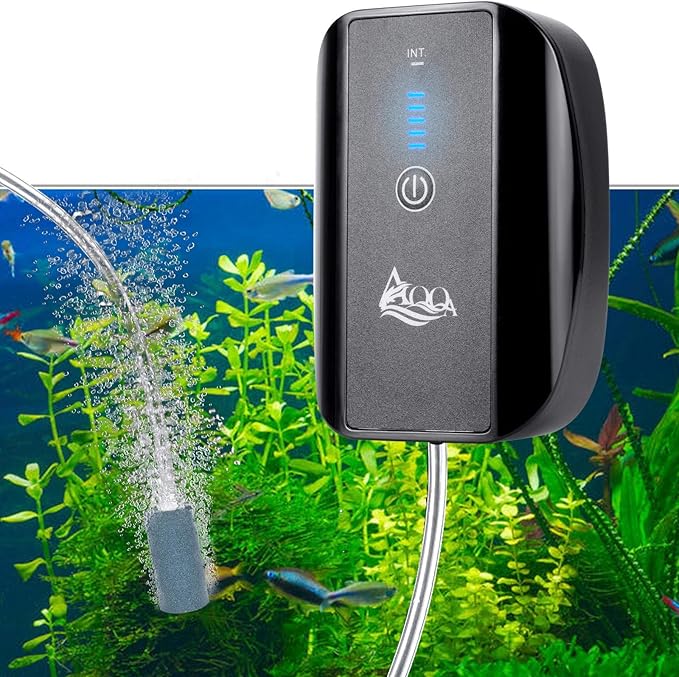
Great for anyone with an aquarium concerned about power outages, it provides steady aeration without needing to be constantly plugged in. Its standout feature is the built-in rechargeable battery that kicks in automatically when electricity goes out, keeping air flowing to your fish even when you’re away.
Setup is straightforward thanks to the USB connector, which makes charging easy. You can keep it plugged in for daily use or rely on the battery during emergencies. It offers two modes: Normal for continuous air flow and Intermittent to stretch battery life.
Switching between these modes helps manage runtime based on your tank’s needs and your schedule.
The pump delivers 1.7 liters of air per minute, enough to keep oxygen levels steady in small to medium tanks. It runs quietly and is compact, so it doesn’t take up much space. Most people like that it switches to battery power automatically during outages.
A common complaint is that the pressure level is quite low at 0.02 pascal, which might not meet heavy aeration demands.
The pump is praised for its automatic switch to battery power during outages, ensuring fish safety without manual intervention. Most users note the low air pressure as a limitation, which reduces effectiveness in larger tanks or setups needing stronger aeration.
This product is perfect for aquarium keepers seeking reliable backup aeration for small to medium tanks. Those needing strong continuous airflow or longer battery life should consider alternatives better suited for heavy-duty use.
Pros
- Automatically switches to battery during power loss
- USB rechargeable lithium-ion battery
- Two operating modes for tailored runtime
- Compact and quiet design
Cons
- Low maximum air pressure of 0.02 pascal
- Battery lasts only about 14–18 hours on full charge
| Specification | Details |
|---|---|
| Power Source | Battery Powered |
| Air Flow Capacity | 1.7 liters per minute |
| Maximum Pressure | 0.02 pascal |
| Operation Mode | Automatic |
| Battery Type | Lithium-ion |
| Connector Type | USB |
11. Hygger Dual-Outlet Rechargeable Aquarium Air Pump

Power outages can quickly put aquarium fish at risk due to lack of oxygen. Suitable for people with aquariums who want uninterrupted aeration, this air pump features an automatic switch between AC and battery power, keeping your fish safe during blackouts without any manual intervention.
Setup is straightforward: plug it into your regular power source, and it operates like any standard air pump. When the electricity goes out, it immediately runs off its built-in lithium batteries without any noise or disruption.
The dual-outlet design lets you aerate more than one tank at once, making daily use easy for multiple setups.
It delivers a solid airflow of 4.23 gallons per minute, keeping oxygen levels steady in the tank. The built-in 5000mAh lithium-ion batteries last about 20 hours on full power, which is excellent for emergencies.
The casing feels solid and durable, though some people have noticed it can be a bit bulky compared to basic pumps. A few mention that battery life drops faster if used at maximum airflow constantly.
This pump’s top feature is its automatic power switch that keeps aeration going during power failures without any user action. The most common drawback is the battery doesn’t last as long if used continuously at full speed.
People with aquariums looking for dependable backup aeration will find this very handy. Those needing a compact, lightweight pump for small tanks or occasional use might prefer smaller, simpler models.
Pros
- Automatic switch between AC and battery power
- Long-lasting 5000mAh lithium batteries
- Dual outlets for aerating multiple tanks
- Reliable oxygen supply during outages
Cons
- Battery life shortens at maximum airflow
- Bigger size compared to simple air pumps
| Specification | Details |
|---|---|
| Power Source | Corded Electric |
| Air Flow Capacity | 4.23 gpm |
| Battery Type | Lithium-ion |
| Battery Capacity | 5000mAh*2 |
| Continuous Run Time | 20 hours at max airflow |
12. AquaMiracle USB Rechargeable Aquarium Air Pump

Lasting up to 30 hours on a single charge, this aquarium air pump suits tanks up to 60 gallons and stands out for its powerful 2200mAh rechargeable lithium battery. It provides steady airflow without needing constant power from a wall socket, making it perfect for those who want flexibility and portability.
Setting up involves just a USB recharge, which is convenient using laptops or power banks. The pump’s semi-automatic operation cuts down power use by working intermittently, so you don’t have to worry about draining the battery fast. Its lightweight design makes placement easy, and it fits well with common aquarium setups without fuss.
Performance reflects its 1.5 liters per minute air flow rate and solid 15 kilopascal pressure, keeping the tank well-oxygenated day and night. Built with a quiet but strong 2-watt motor, it reliably moves air without adding a lot of noise.
Some users mention the semi-automatic mode is slower than a continuous pump, but most appreciate the long battery life and consistent airflow.
The strongest positive is its long battery life supported by the 2200mAh rechargeable lithium battery, which allows consistent aeration without daily charging. Its main drawback is the semi-automatic operation, which means it does not run continuously and might slow down overall air circulation compared to plugged-in pumps.
Those with medium-sized tanks up to 60 gallons who want portable, quiet aeration will find this pump ideal. People needing constant, high-output air flow or with larger tanks might need a different solution offering continuous operation and stronger power.
Pros
- Lasts 24-30 hours per full charge
- Rechargeable via USB from multiple devices
- Works quietly and efficiently
- Compact and easy to place
Cons
- Semi-automatic mode reduces airflow timing
- May not suit tanks over 60 gallons
| Specification | Details |
|---|---|
| Air Flow Capacity | 1.5 liters per minute |
| Maximum Pressure | 15 kilopascal |
| Power | 2 watts |
| Battery Type | Lithium Ion |
| Operation Mode | Semi-Automatic |
| Power Source | AC/DC |
Best Battery Powered Aerators Comparison Table
| Product | Power Source | Air Flow Capacity | Battery Type | Operation Mode |
|---|---|---|---|---|
| Pawfly Outdoor Aerator | Battery Powered | – | Alkaline | Automatic |
| AquaMiracle USB Pump | AC/DC | 0.06 cfm | Lithium Ion | Semi-Automatic |
| Marine B-3 Aerator | Battery Powered | 1 L/min | 2 D cell alkaline | Automatic |
| hygger Battery Air Pump | – | 1.89 L/min | Lithium Ion | – |
| Pawfly Portable Pump | Battery Powered | 0.67 gpm | Alkaline | Manual |
| fishkeeper Rechargeable Pump | Corded Electric | 113 L/h | Lithium | Manual |
| Outdoor Portable Aerator | – | – | – | – |
| Small Fish Tank Pump | Battery Powered | – | D | Automatic |
| Pawfly Ultra Quiet Aerator | Battery Powered | 0.42 gpm | Lithium-ion | Automatic |
| AQQA USB Pump | Battery Powered | 1.7 L/min | Lithium-ion | Automatic |
| hygger Dual-Outlet Pump | Corded Electric | 4.23 gpm | Lithium-ion | – |
| AquaMiracle Rechargeable Pump | AC/DC | 1.5 L/min | Lithium Ion | Semi-Automatic |
- Power SourceBattery Powered
- Air Flow Capacity–
- Battery TypeAlkaline
- Operation ModeAutomatic
- Power SourceAC/DC
- Air Flow Capacity0.06 cfm
- Battery TypeLithium Ion
- Operation ModeSemi-Automatic
- Power SourceBattery Powered
- Air Flow Capacity1 L/min
- Battery Type2 D cell alkaline
- Operation ModeAutomatic
- Power Source–
- Air Flow Capacity1.89 L/min
- Battery TypeLithium Ion
- Operation Mode–
- Power SourceBattery Powered
- Air Flow Capacity0.67 gpm
- Battery TypeAlkaline
- Operation ModeManual
- Power SourceCorded Electric
- Air Flow Capacity113 L/h
- Battery TypeLithium
- Operation ModeManual
- Power Source–
- Air Flow Capacity–
- Battery Type–
- Operation Mode–
- Power SourceBattery Powered
- Air Flow Capacity–
- Battery TypeD
- Operation ModeAutomatic
- Power SourceBattery Powered
- Air Flow Capacity0.42 gpm
- Battery TypeLithium-ion
- Operation ModeAutomatic
- Power SourceBattery Powered
- Air Flow Capacity1.7 L/min
- Battery TypeLithium-ion
- Operation ModeAutomatic
- Power SourceCorded Electric
- Air Flow Capacity4.23 gpm
- Battery TypeLithium-ion
- Operation Mode–
- Power SourceAC/DC
- Air Flow Capacity1.5 L/min
- Battery TypeLithium Ion
- Operation ModeSemi-Automatic
How to Choose the Right Battery Powered Aerator
Choosing a good battery powered aerator depends on battery life, aeration capacity, and durability to ensure efficient performance and long-lasting use. Getting these factors right helps avoid frequent replacements and repairs, saving time and money while maintaining healthy soil or water conditions.
Battery Life and Charging
A typical session with these devices can last anywhere from 4 to 10 hours on a full charge, depending on the battery type and capacity. Lithium-ion batteries tend to hold their charge longer and cycle better than lead-acid ones, making a noticeable difference in how often you need to recharge.
A battery rated around 12V and 10Ah usually provides a good balance of power and runtime for moderate aeration tasks.
Charging time varies but expect roughly 4-6 hours for a full charge with standard chargers. Some models offer USB charging or fast-charge options, which can be convenient if you use the aerator frequently.
Having a removable battery pack speeds up turnaround since you can charge one while using another. Skipping these details means more downtime and interrupts your maintenance routine.
Aeration Performance
Air output and flow rate directly affect how well the oxygen distributes through water or soil. Devices with an output capacity of around 2-4 cubic feet per minute usually handle small to medium-sized ponds or garden beds effectively.
Lower capacities might struggle to reach deeper or wider areas, leaving parts untreated.
More powerful units push air deep and evenly, promoting healthier aquatic environments or soil conditions. Look for aerators with adjustable flow or diffusers that spread bubbles uniformly. Those without proper flow rates can cause insufficient oxygenation, resulting in clogged water or compact soil that won’t support plant life as well.
Portability and Design
Weight and size make a big difference when moving the unit around. Those around 5 to 10 pounds feel manageable and won’t tire you out after repeated use.
Compact designs fit easily into garden sheds or trunks, which helps with storage. Ergonomic handles or grips improve control during setup and repositioning.
Plastic or aluminum housings resist rust and stand up well to rain or sun exposure. Some bulky or cheaply made units can crack or corrode after a season outdoors.
Durable materials paired with thoughtful design make the daily use less frustrating and prolong the device’s lifespan under tough conditions.
Noise Level
Noise levels typically range between 45 and 65 decibels. At the higher end, the constant sound can disturb neighbors or wildlife, especially in quiet rural settings.
Models rated below 50 decibels blend into background noise better and reduce complaints.
Some units include noise-dampening features like rubber mounts or insulated casings. Without such features, vibration or rattling worsens noise pollution and feels intrusive.
Selecting a quieter option is especially valuable if the aerator runs for several hours or overnight near living spaces or natural habitats.
Maintenance and Durability
Designs that allow quick access to the air intake or diffusers make regular cleaning easier. Debris build-up quickly reduces performance, so smooth, removable parts save time and effort.
Units made from corrosion-resistant stainless steel or coated metals better withstand moisture and soil acidity.
Parts like tubing or replacement batteries should be easy to find and swap without special tools. Models with proprietary components often cause delays and added expense when repairs are needed.
A straightforward design focused on maintenance keeps the aerator functional through multiple seasons with minimal hassle.
Tips for Maximizing Battery Life and Performance in Aerators
Battery powered aerators depend heavily on how you manage their charge cycles to get the best runtime. Avoid fully draining the battery before recharging, as this can reduce battery lifespan. Instead, plug the device in once the battery drops to about 20-30% capacity.
This approach helps maintain stable battery health over many uses.
Temperature also plays a role in battery efficiency. Store and operate the aerator in moderate temperatures to prevent battery degradation caused by extreme heat or cold.
While running, keep the battery clean from dirt and moisture, which can affect contacts and performance.
- Charge with the original charger to avoid damage.
- Turn off the aerator immediately after use to conserve power.
- Use the battery power settings as recommended in the manual to balance air delivery and runtime.
Following these tips can extend your battery life and ensure the aerator performs consistently in your lawn care tasks.
Essential Maintenance and Care Practices for Battery Powered Aerators
Keeping your battery powered aerator in good shape involves regular inspection and cleaning. After each use, wipe down the external surfaces to remove dirt, grass clippings, and any residue. This prevents buildup that can impair the motor and moving parts.
Check the aerator’s tines for wear or bending. Replace them when they become dull, as sharp tines improve soil penetration and reduce strain on the motor.
Look closely at battery terminals and connectors periodically; corrosion or looseness can cause starting issues.
- Store the aerator in a dry, sheltered spot to avoid rust and moisture damage.
- Charge the battery fully before storing for long periods.
- Follow manufacturer instructions for tightening bolts and inspecting belts if applicable.
Proper maintenance prevents costly repairs and keeps the machine running smoothly season after season.
Comparing Battery Powered Aerators with Traditional Plug-In and Gas Models
Battery powered aerators offer the convenience of cordless operation, which lets you move freely without worrying about power outlets or running fuel lines. They tend to be lighter and quieter than gas models, making them easier to handle and better suited for residential lawn care.
Traditional plug-in aerators deliver consistent power as long as they remain connected, but their cords limit mobility and pose a tripping hazard. Gas-powered aerators provide the most power, suitable for larger or heavily compacted lawns, but they require more maintenance and produce noise and fumes.
- Battery aerators require charging time but avoid fuel storage and emissions.
- Gas models are heavier and need periodic engine maintenance.
- Electric plug-in units restrict movement to the length of the power cord.
The choice depends on lawn size, noise tolerance, and preferences about ease of use and upkeep.
People Also Asked
How Long Does a Battery Powered Aerator Typically Last on One Charge?
Most battery powered aerators run about 6 to 12 hours on a single charge. Running them within this range ensures good oxygen levels without draining the battery fully. Carrying a spare battery or charging between uses can keep aeration continuous.
What Size Battery Powered Aerator Do I Need for My Pond?
Choose an aerator sized by pond volume; smaller ponds up to 1,000 gallons need less powerful units. Checking the aerator’s coverage rating helps avoid under or over-aerating. Match the model to your pond’s size for efficient oxygen circulation.
Are Battery Powered Aerators Safe to Use in Small Fish Tanks?
Battery powered aerators designed for ponds generally are not suitable for small fish tanks. They can create too much current or noise. For tanks under 50 gallons, quieter, smaller air pumps or internal filters work more effectively.
How Do I Properly Maintain and Clean a Battery Powered Aerator?
Cleaning the aerator involves rinsing the diffuser and props with fresh water regularly to prevent clogging. Avoid chemical cleaners as they can damage parts. Store it dry and charge batteries after use to prolong aerator life.
What Are Common Problems with Battery Powered Aerators and How Fix Them?
Common issues include battery not holding charge or diffuser clogging. Replacing batteries when performance fades and cleaning the air holes with a gentle brush usually resolve these. Avoid submerging the motor part to prevent water damage.
Conclusion
Choosing a battery powered aerator comes down to runtime, aeration depth, and how easy it is to move around your yard. A longer battery life means you can cover more ground without stopping to recharge. Look for a model that can reach the soil depth your lawn needs to breathe properly.
Also, consider the weight and handle design so you can work comfortably without tiring quickly.
Think about your lawn size and budget before making a decision. For smaller yards, a compact unit with moderate runtime might be enough.
Bigger yards or frequent use call for longer battery life and stronger aeration. Check the comparison table and detailed picks above to find a tool that fits your specific needs and helps keep your grass healthy.

I’m Jake Thompson, and I’ve spent over a decade working on lawn mowers, from small push mowers to big riding tractors. I write about starting problems, blade sharpening, carburetor cleaning, oil changes, and seasonal maintenance. My goal is to give you clear, step-by-step advice so you can handle common mower issues yourself and keep your lawn looking sharp all season.