Top 12 Best 3in 1 Soil Meter That Will Transform Your Garden
Gardening often hits a snag when soil meters give inconsistent readings or break after a few uses. The best 3in 1 soil meter avoids these issues by offering reliable moisture, pH, and light level measurements without requiring frequent recalibration.
Cheaper models tend to have weak probes or unclear displays, making it hard to trust their results and adjust care properly.
Durability and accuracy are key in these meters. Sturdy metal probes resistant to corrosion last longer and provide stable readings. The meter should measure moisture from 0 to 100 percent, with pH ranging roughly between 3.5 and 8, covering most garden soils.
Size matters too; a compact unit with easy-to-clean probes saves time and effort during regular checks. Battery-free or low-power designs also reduce maintenance hassle.
Need a Quick Check?
| Image | Product | Price |
|---|---|---|
Our Top Picks 1  | SONKIR pH Meter | Check Price |
Our Top Picks 2  | VIVOSUN Moisture Meter | Check Price |
Our Top Picks 3  | 2-Pack Soil Tester | Check Price |
Our Selected Top 12 3in 1 Soil Meter for Different Needs
This list features a variety of 3in 1 soil meters designed for different gardening needs and skill levels. Each review covers how well the meter measures soil conditions, who it is best suited for, and its main advantages and limitations.
1. SONKIR MS02 Soil pH Meter
Great for gardeners wanting a straightforward tool, it measures soil moisture, pH, and sunlight without batteries. Ideal for those who want a simple, reliable way to check soil conditions before planting or maintenance.
Its biggest strength is the easy-to-read display and multifunction capability in one compact meter.
Setting it up is as simple as inserting the probes into damp soil and waiting a couple minutes. No batteries needed means it’s always ready, and switching between moisture, pH, and sunlight modes is done with a single button press.
It’s important to water dry soil before testing to get accurate readings, so a bit of preparation helps. The compact size fits comfortably in hand, making it easy to use around the garden.
It performs well in giving quick, practical soil data, and the sturdy build supports long-term use without breaking down. The main praise centers on its reliability and easy operation. A common downside is that it can’t test liquids or extremely dry soil without watering first, which limits flexibility in some cases.
Despite that, the materials feel solid and it looks like it will last through multiple gardening seasons.
Praise often highlights how reliable the meter is and how simple it is to use, making soil testing accessible without any fuss. The most frequent complaint is about the inability to measure soil pH when the soil is too dry or when trying to test liquids, requiring users to water the soil beforehand.
Those who want a basic and dependable soil tester to track moisture, pH, and sunlight will find this tool suitable. Anyone needing to test liquid samples or very dry soils regularly should consider other options that handle these conditions better.
Pros
- Measures moisture, pH, and sunlight in one device
- No batteries required for operation
- Easy to switch between testing modes
- Lightweight and compact design for portability
Cons
- Cannot test pH in liquids
- Needs soil to be moist for accurate readings
| Specification | Details |
|---|---|
| Product Dimensions | 11.5 x 2 x 1.5 inches |
| Item Weight | 2.89 ounces |
| Functionality | Moisture, pH, and Sunlight levels measurement |
| Power Source | No battery needed |
| Model Number | MS02 |
2. VIVOSUN Plant Soil Moisture Meter
Metal probes and a compact 10.8-inch design make this soil meter light enough to carry around while being sturdy. Perfect for gardeners who want quick insights on soil moisture, light, and pH levels all from one tool.
Its standout feature is the ability to switch between three measurements with just one button.
Using the meter is straightforward: just insert the probes into the soil after choosing the mode. No batteries are needed, which keeps it simple and reliable.
Switching between moisture, light, and pH readings involves pressing a button on the handle. It’s handy for both indoor potted plants and outdoor garden beds due to its compact size.
The meter reads soil moisture from 1 to 10, light from 0 to 2000, and pH from 3.5 to 8. It provides clear, quick readings that make adjusting care easier. It feels durable and well-built, although some mention the pH readings can be less precise. The main praise is about how it helps take better care of plants by giving multiple soil readings in one device.
The tool is praised for making plant care more efficient by combining moisture, light, and pH testing in one unit with clear readings. Common feedback points to the pH accuracy being less consistent compared to other soil tests. It remains a reliable and straightforward device for regular soil measurements.
Gardeners who want quick, portable, and battery-free soil testing will find this meter useful. Those requiring highly precise pH data might prefer a dedicated pH meter or lab testing for critical soil conditions.
Pros
- Single button switches between three tests
- Compact and easy to carry around
- No battery needed for operation
- Measures moisture, light, and pH levels
Cons
- Not suitable for testing liquids other than soil
- Accuracy of pH readings can vary
| Specification | Details |
|---|---|
| Testing Range Moisture | 1-10 (dry to moist) |
| Testing Range Light | 0-2000 (low light to strong light) |
| Testing Range pH | 3.5-8 (acidic to basic) |
| Length | 10.8 inches |
| Battery Required | No |
| Model | 4316237907 |
3. 2 Pack Soil Moisture Meter 3-in-1 Tester
Slim and easy to handle, this soil meter is ideal for gardeners wanting quick checks on moisture, light, and pH levels. It suits those with multiple planting spots since it comes in a handy two-pack with different colors to avoid mix-ups. Its key strength lies in combining three essential soil tests in one compact device.
Set up takes no time, just pull the switch to choose between moisture, light, or pH testing. Its 10.8-inch length allows you to insert it right where you need without disturbing the soil too much.
Daily use is straightforward as you simply stick it into the soil and read the results immediately. Having two colors helps when monitoring various garden areas at once.
Accuracy in moisture readings ranges from 1 to 10, giving a clear scale for dry to moist soil. The build is simple but functional, with a small monitor that slips easily into soil. Most praise revolves around its easy switching between modes and usefulness, while the main complaint mentions the need for battery power and occasional calibration concerns.
The meter impresses with its multi-function testing and clear, immediate readings, greatly aiding in garden monitoring. On the downside, reliance on batteries and occasional calibration needs can be minor inconveniences.
Those wanting a compact, all-in-one soil tester for multiple areas will appreciate this two-pack. People looking for a fully mechanical or battery-free option might want to consider other tools.
Pros
- Tests moisture, light, and pH values
- Two-color pack for easy area differentiation
- Compact size saves gardening space
- Simple switch to select testing mode
Cons
- Requires battery power
- Some users note need for occasional calibration
| Specification | Details |
|---|---|
| Power Source | Battery Powered |
| Measurement Type | Ohmmeter |
| Length | 10.8 inches |
| Moisture Range | 1 to 10 (dry to moist) |
| Pack Quantity | 2 |
| Colors Included | Black and Green |
4. Apine 3-in-1 Soil Moisture and pH Meter

Accuracy and convenience stand out when checking soil conditions, which is why this one-click 3-in-1 soil meter is ideal for home gardeners and plant enthusiasts aiming for quick, reliable measurements. It combines moisture, pH, and light intensity checks in a single tool, saving time and effort.
Getting started means simply inserting the probe 2 to 4 inches into the soil and pressing one button to cycle through moisture, pH, and light readings. There’s no complicated setup or calibration needed.
The controls are easy to use, making daily monitoring straightforward whether you’re tending to indoor pots or garden beds.
The meter delivers readings quickly thanks to upgraded double probes made of aluminum and copper nickel-plated materials, which provide strong conductivity and resist corrosion better than older copper models. The most common praise focuses on the fast and accurate measurements, while some point out that the probe length might limit use in very dense or rocky soils.
Fast readings and reliable measurements are the best features appreciated here, with the durable probe materials standing out. Complaints mostly focus on the shorter probe length making deep or tough soils harder to test.
This suits anyone wanting quick, general soil data for common plants and gardens. Those needing deeper soil analysis or more precise pH readings might want to look at meters with longer probes or more advanced digital displays.
Pros
- Quick one-click switching between tests
- Corrosion-resistant aluminum and copper probes
- Lightweight and portable at under 3 ounces
- Accurate results with high sensitivity
Cons
- Probe length may not suit very rocky or compact soil
- No digital display for detailed numerical values
| Specification | Details |
|---|---|
| Package Dimensions | 10.35 x 2.52 x 1.57 inches |
| Item Weight | 2.89 ounces |
| Manufacturer | apine |
5. Digital 4-in-1 Soil Moisture and pH Meter

When looking after plants, knowing soil moisture, pH, temperature, and sunlight conditions are key for keeping them healthy. A device that combines all these measurements in one tool fits well for gardeners or anyone caring for indoor and outdoor plants.
Its biggest strength lies in giving quick, easy-to-read soil insight on a large backlit screen.
Setup is straightforward: insert four AAA batteries to power the device. During daily use, simply insert it into the soil and check the large LCD screen that clearly shows moisture, pH, temperature, and sunlight levels, even in low light due to the backlight. The digital readouts make it easy to decide when watering or adjusting plant exposure is needed.
The meter delivers reliable readings across four measurements with temperature range from 32 °F to 122 °F and accuracy within 1.8 °F. Constructed to stand freely without extra mounting, it feels solid but is lightweight. Most praise focuses on its multi-functionality and display clarity. The main complaint revolves around batteries not being included in the package.
Most users appreciate the large, clear digital display showing four different soil parameters at once, all from a single handheld device. A frequent downside is the need to purchase AAA batteries separately, which can delay immediate use.
Those who spend time gardening and want a simple, multifunctional tool for monitoring soil conditions will be satisfied with this meter. People needing wider temperature ranges or who prefer included batteries might consider alternative models.
Pros
- Measures moisture, pH, temperature, and sunlight simultaneously
- Large LCD with white backlight for easy reading
- Accurate temperature readings within 1.8 °F
- Freestanding design for simple placement
Cons
- Batteries not included, need to buy separately
- Limited temperature range may not suit extreme climates
| Specification | Details |
|---|---|
| Lower Temperature Range | 32 °F |
| Upper Temperature Range | 122 °F |
| Temperature Accuracy | 1.8 °F |
| Voltage | 6 volts |
| Battery Type | AAA 1.5V * 4 (not included) |
| Mounting Type | Freestanding |
6. 7-in-1 Digital Soil Moisture Meter

Measuring seven important plant care factors in one device makes monitoring your garden simple and precise. Perfect for gardeners who want clear, numerical feedback on moisture, pH, temperature, light, and fertility, it shines with its clear LCD backlight that works well day or night.
Setting up involves inserting four AAA batteries, which power the device for daily checking during different times and lighting conditions. The large screen lights up with numerical values, letting you see exact readings quickly in the sunshine or darker corners of your garden. Functions like EC and TDS help decide watering times based on real soil conditions, not guesswork.
The main task of measuring soil conditions is handled well, giving straightforward and reliable results for moisture, pH, and temperature. Durable build keeps it functional for extended periods, though some people find battery replacement necessary sooner than expected.
The display is praised for its clarity, while occasional complaints mention that handling with wet or heavy soil can be a bit tricky.
Clear and readable numbers on the backlit screen are the best part, making it easy to get accurate soil readings anytime. Common drawbacks include the need to change batteries regularly and some difficulty using it in wetter or compacted soils. It balances multiple features in one tool without clutter.
Anyone serious about precise garden care will find this device useful, especially for monitoring multiple soil aspects without buying separate meters. Those working in heavy clay or very wet soil might want to consider a sturdier or waterproof option instead for more convenience.
Pros
- Measures seven soil factors in one device
- Clear numerical readings with backlit display
- Lightweight at 5.6 ounces for easy handling
- Fertility feature helps improve plant care
Cons
- Batteries not included, need to be bought separately
- Probes can be tricky with very moist or dense soils
| Specification | Details |
|---|---|
| Package Dimensions | 11.61 x 2.68 x 1.85 inches |
| Item Weight | 5.6 ounces |
| Power | Four 1.5V AAA batteries (not included) |
| Manufacturer | Buladeke |
| Display | Large LCD with white backlight |
7. 4-in-1 Soil Moisture and pH Meter
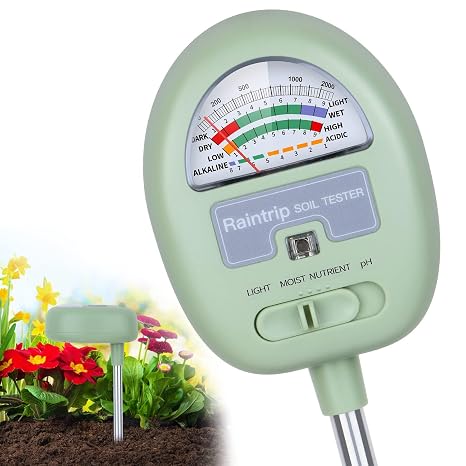
Gardeners wanting a tool that offers a full plant health check will appreciate this 4-in-1 Soil Moisture and pH Meter. It suits people who want more than just soil moisture readings. Its biggest strength lies in combining moisture, pH, nutrient, and light level tests in one handheld device.
Setting it up involves no batteries, which makes it simple to start using right away. The 90° rotating dial means you don’t have to bend down to read measurements, making checking your plants more comfortable.
The free plant growing guide and sandpaper ensure better maintenance and understanding of what your plants need day-to-day.
Performance is reliable for typical gardening needs. The meter provides detailed results on several soil aspects, helping quickly identify what your plants require. Its build feels sturdy and designed to be manageable on a tabletop.
The most often praised feature is the readability at a 90° angle, while the most frequent complaint mentions that the nutrient testing may not be as accurate as specialized testers.
Ease of reading thanks to the rotating dial stands out as the most appreciated feature, reducing strain during plant care. Nutrient measurement accuracy appears less reliable compared to dedicated devices, which may affect detailed fertilization decisions.
People wanting a versatile device that covers several plant health aspects without needing extra power will find this useful. Those requiring highly precise nutrient testing or needing more portable designs might want to look elsewhere.
Pros
- Monitors multiple soil factors in one device
- No batteries needed for operation
- 90° adjustable dial eases reading of results
- Includes free plant guide and sandpaper for upkeep
Cons
- Nutrient readings can be less accurate than specialized meters
- Designed primarily for tabletop use, limiting portability
| Specification | Details |
|---|---|
| Battery Description | No batteries required |
| Mounting Type | Tabletop |
| Temperature Accuracy | 1 |
| Dial Design | 90° Rotating (U.S. Patent No. D968976) |
| Functions | Moisture, pH, Nutrient, Light Level |
8. HSLGOVE 7-in-1 Soil Test Kit

Designed for anyone curious about their garden’s soil health, the HSLGOVE 7-in-1 Soil Test Kit stands out by measuring seven key factors all in one device. It’s particularly suitable for beginners wanting detailed insights without juggling multiple tools, with the clear LCD screen as its biggest plus.
Setting up involves installing three batteries each time, then toggling the dial between %RH/°F for power on and LIGHT for power off. Switching between soil moisture, pH, fertility, temperature, light, indoor temperature, and humidity modes happens through a single button.
You get measurement results on the LCD display in 3 to 5 minutes, making daily use straightforward once you get the hang of the dial and buttons.
Performance is solid for a beginner tool, accurately providing multiple readings in a reasonable time. The 1.6-inch chip board seems reliable and suits indoor and outdoor soil checks. At 4.8 ounces, it’s lightweight but the smallest complaint is having to replace all three batteries on each power cycle, which some find inconvenient.
Build quality fits its price range but feels functional rather than premium.
Users appreciate the clear, multi-factor readings the device offers after just a few minutes of testing. A repeated issue comes from having to replace all three batteries every time it’s powered on, which can be inconvenient and costly over time.
This soil test kit suits gardeners new to soil testing who want a wide range of measurements in one handheld device. Anyone needing quick, simple measurements without dealing with liquids will find it useful. People wanting a water moisture meter or less frequent battery upkeep might want to consider other options.
Pros
- Measures seven soil and environment factors
- Clear LCD screen for easy result reading
- Lightweight and easy to handle
- Single-button mode switching simplifies use
Cons
- Requires replacing all three batteries each time
- Not suitable for testing liquid moisture
| Specification | Details |
|---|---|
| Product Dimensions | 11.5 x 2.9 x 1.5 inches |
| Item Weight | 4.8 ounces |
| Model Number | 001 |
| Functions | Moisture, pH, fertility, temperature, light, indoor temp, humidity |
| Display | 1.6″ LCD screen with dial |
9. HSLGOVE 2-in-1 Soil Moisture and pH Meter

HSLGOVE 2-in-1 Soil Moisture and pH Meter combines two important garden tools into one simple device. Perfect for anyone who wants to monitor their plants’ soil without fuss, its biggest strength is providing moisture and pH readings simultaneously, saving time and guesswork.
Setting up involves just sticking the two probes into the soil, no batteries or complicated switches to worry about. The dual-dial display means you see moisture and pH levels at the same time, making daily checks straightforward.
It’s compact and lightweight, so moving it around the garden or pots feels natural without any extra effort.
It reliably measures soil moisture and pH levels with clear dials that are easy to read outdoors. The all-in-one design cuts down on tools needed for basic soil care.
The build feels sturdy enough for regular use, though some mention the readings can vary a little depending on soil type. Compactness and battery-free operation are praised most.
This tool gets high marks for providing useful moisture and pH readings at a glance without the need for batteries. Most find it easy to use outdoors, though some note the accuracy can shift a bit depending on soil conditions. The dual dials help avoid switching modes or guessing measurements.
People wanting a basic, simple gadget to keep an eye on soil conditions will find it handy. Those needing lab-level accuracy or those gardening in highly varied soils might want a more specialized meter. It fits casual gardeners and plant hobbyists best.
Pros
- Measures moisture and pH simultaneously
- No batteries needed for operation
- Lightweight and easy to handle
- Clear dual-dial display
Cons
- Readings may vary with different soil types
- Build quality could be sturdier
| Specification | Details |
|---|---|
| Product Dimensions | 11.3 x 1.4 x 2.5 inches |
| Item Weight | 3.2 ounces |
| Manufacturer | HSLGOVE |
| Item model number | 001 |
| Features | Soil moisture meter and soil pH meter combined |
10. 3-in-1 Soil Moisture and Nutrient Tester

Checking soil moisture, fertility, and pH all in one tool simplifies plant care especially for beginners or casual gardeners. What stands out the most is how quickly you get reliable readings from the soil, helping avoid both overwatering and underwatering. The color-coded scale makes it clear when the soil needs attention without any guesswork.
Setting it up is straightforward; just insert the probe deeply into the soil, more than two-thirds down, and wait about 3 seconds for a reading. Switching between moisture, fertility, and pH modes is as easy as toggling a button, making daily soil checks simple.
When the probe meets resistance, trying a new spot quickly solves the problem. The included manual makes it easy to understand each reading.
Accuracy on moisture levels is dependable, showing whether your soil is dry, ideal, or too wet using a red, green, and blue color system. The unit feels solid with a well-built probe, though some users mention occasional difficulty inserting the probe in tougher soil. The most praised feature is the combination of three tests in one device, while the most common complaint revolves around struggling with very hard or rocky soil.
The 3-in-1 Soil Moisture and Nutrient Tester is praised for combining three essential soil tests in a single tool with quick, easy-to-read results. A common issue is the difficulty in inserting the probe into hard or rocky soil, which can slow down the measuring process.
People who want a straightforward device to monitor basic soil conditions will appreciate this tester. Those dealing with very compacted or gravel-heavy soil might want to consider models with sturdier probes designed for tougher terrain.
Pros
- Measures moisture, fertility, and pH in one device
- Quick readings within 3 seconds
- Color-coded scale for easy understanding
- Compact and simple to operate
Cons
- Probe can be hard to insert in dense soil
- Some resistance when used in rocky soil
| Specification | Details |
|---|---|
| Brand Name | Soonkoda |
| Model | 3-in-1-bodentester |
| Manufacturer | Dongguan DONGYIDA Electronics Co.,Ltd |
| Number of Items | 1 |
| Included Components | Soil Tester, English Manual, Paper Box |
11. 3-in-1 Soil pH Meter

Simple and reliable tool for anyone needing quick checks of soil moisture, pH, and sunlight. Best suited for gardeners and hobby farmers who want a straightforward device without fuss.
Its biggest strength lies in not needing batteries, making it ready to use anytime without charging or replacements.
Setup is minimal since it doesn’t require batteries. Just make sure the soil is moist enough before testing, especially if the ground feels dry. Switching between moisture, pH, and sunlight measurements is done by a single function button, so daily checks are fast and easy whether you’re inside or working outdoors in your garden or lawn.
It measures moisture, pH, and sunlight accurately for regular gardening needs. The build feels solid and reliable with materials that hold up outdoors.
The most praised feature is its battery-free operation, which means no interruptions during use. Some find it less accurate on very dry soils unless they water the soil first.
Many users appreciate the convenience of its no-battery operation, allowing immediate use anywhere without power concerns. However, the device requires adequately watered soil to provide accurate pH results, which some find less practical when dealing with dry soil. It delivers reliable moisture and sunlight readings in everyday garden settings.
People who check soil conditions regularly and want a lightweight, multifunctional tool will benefit most from this meter. Those who need to test pH in very dry soil or want to measure liquids other than soil should consider different specialized meters.
Pros
- Three functions in one device
- No batteries needed for use
- Lightweight and easy to carry
- Works indoors and outdoors
Cons
- Not suitable for liquids other than soil
- Needs moist soil for accurate pH readings
| Specification | Details |
|---|---|
| Product Dimensions | 10.4 x 1.5 x 2.5 inches |
| Item Weight | 0.634 ounces |
| Manufacturer | Speedinistic |
| Item Model Number | SPEED-003 |
12. Fiddle Leaf Fig 3-in-1 Soil Tester

Plastic construction designed specifically for fiddle leaf figs makes this meter a tailored choice for plant lovers focused on this popular houseplant. Its biggest strength lies in offering precise readings for pH, moisture, and sunlight, helping maintain the optimal environment for fiddle leaf fig growth indoors.
Day-to-day use involves simply sticking the sensor into the plant’s sandy soil to get quick and accurate levels of moisture, pH, and light exposure. No complicated setup or batteries needed, making it low maintenance.
The clear readings give straightforward guidance on when to water or adjust the plant’s light conditions without guessing.
Performance lives up to its purpose by providing comprehensive soil analysis that helps avoid root rot from overwatering or leaf burn from too much sun. The build is simple yet functional. Users praise its ease of use and precise readings but some note that it’s designed only for fiddle leaf figs, limiting versatility for other plants.
Strongest praise comes from accurate and easy-to-read soil condition measurements that prevent overwatering and sun damage. Most common complaint is its narrow focus on fiddle leaf figs and sandy soil, which reduces usefulness for other plant types or soil conditions.
Gardeners dedicating attention solely to fiddle leaf figs will find this meter a practical tool for monitoring health. Those with multiple plant species or varied soil preferences are better served by a more versatile tester designed for broader use.
Pros
- Precise soil moisture measurement
- Measures pH and sunlight exposure too
- Low maintenance with no batteries needed
- Tailored for fiddle leaf fig care
Cons
- Only suitable for indoor use
- Limited to sandy soil types
| Specification | Details |
|---|---|
| Indoor Outdoor Usage | Indoor |
| Designed for Plant Type | Fiddle Leaf Fig |
| Soil Type | Sandy Soil |
| Moisture Needs | Moderate Watering |
| Expected Plant Height | 65 centimeters |
| Expected Blooming Period | Year Round |
Comparison of Top 3 in 1 Soil Meters
| Product | Dimensions | Weight | Power | Manufacturer |
|---|---|---|---|---|
| SONKIR pH Meter | 11.5 x 2 x 1.5 in | 2.89 oz | – | Sonkir |
| VIVOSUN Moisture Meter | – | – | Battery-Free | VIVOSUN |
| 2-Pack Soil Tester | – | – | Battery Powered | – |
| apine 3-in-1 Meter | 10.35 x 2.52 x 1.57 in | 2.89 oz | – | apine |
| Digital 4-in-1 Meter | – | – | 6 volts | – |
| 7-in-1 Digital Meter | 11.61 x 2.68 x 1.85 in | 5.6 oz | – | Buladeke |
| 4-in-1 Moisture Meter | – | – | No batteries | – |
| HSLGOVE 7-in-1 Kit | 11.5 x 2.9 x 1.5 in | 4.8 oz | – | HSLGOVE |
| HSLGOVE 2-in-1 Meter | 11.3 x 1.4 x 2.5 in | 3.2 oz | – | HSLGOVE |
| 3-in-1 Nutrient Tester | – | – | – | Dongguan DONGYIDA |
| 3-in-1 pH Meter | 10.4 x 1.5 x 2.5 in | 0.634 oz | – | Speedinistic |
| Fiddle Leaf Tester | – | – | – | – |
- Dimensions11.5 x 2 x 1.5 in
- Weight2.89 oz
- Power–
- ManufacturerSonkir
- Dimensions–
- Weight–
- PowerBattery-Free
- ManufacturerVIVOSUN
- Dimensions–
- Weight–
- PowerBattery Powered
- Manufacturer–
- Dimensions10.35 x 2.52 x 1.57 in
- Weight2.89 oz
- Power–
- Manufacturerapine
- Dimensions–
- Weight–
- Power6 volts
- Manufacturer–
- Dimensions11.61 x 2.68 x 1.85 in
- Weight5.6 oz
- Power–
- ManufacturerBuladeke
- Dimensions–
- Weight–
- PowerNo batteries
- Manufacturer–
- Dimensions11.5 x 2.9 x 1.5 in
- Weight4.8 oz
- Power–
- ManufacturerHSLGOVE
- Dimensions11.3 x 1.4 x 2.5 in
- Weight3.2 oz
- Power–
- ManufacturerHSLGOVE
- Dimensions–
- Weight–
- Power–
- ManufacturerDongguan DONGYIDA
- Dimensions10.4 x 1.5 x 2.5 in
- Weight0.634 oz
- Power–
- ManufacturerSpeedinistic
- Dimensions–
- Weight–
- Power–
- Manufacturer–
How to Choose the Best 3in1 Soil Meter
Look for a soil meter that accurately measures moisture, pH, and sunlight to ensure healthy plant growth. Choosing a reliable and easy-to-use device saves money by avoiding overwatering or incorrect soil treatments. Durability and clear readings also reduce frustration and extra effort.
Measurement Accuracy
Soil readings can vary wildly depending on the meter’s ability to handle different soil types and environmental conditions. Some meters give inconsistent moisture or pH values if the probes aren’t sensitive enough or if the device lacks proper calibration.
This confusion leads to poor plant care decisions, like overwatering or applying incorrect nutrients.
Reliable models provide clear, precise readings for moisture, pH, and light intensity that hold steady across sandy, clay, or loamy soils. A good meter often includes simple calibration steps or auto-calibration features to maintain accuracy over time.
Pay attention to products that specify their measurement ranges clearly: pH usually covers 3.5 to 8, moisture from 1 to 10 (or similar scale), and light measured in Lux, appropriate for average indoor/outdoor gardening.
Sensor Quality and Durability
Probes made from stainless steel or other corrosion-resistant metals stand up well to moisture and soil acids, which quickly degrade cheaper metals. Plastic housings should feel solid, without flimsy seams that let dirt or water inside.
Durability matters most for tools used regularly outdoors in unpredictable weather.
Probe length typically ranges between 4 to 7 inches, balancing deep soil access with enough sturdiness to avoid bending or breaking. The shape also matters: slim, slightly tapered probes slide easier into dirt without excessive force.
Rough or brittle designs often end with damaged sensors and unreliable readings.
User Interface and Display
Strong contrasts and large enough text on the display help when working in bright sunlight or dim greenhouses. Some screens use backlighting or anti-glare layers to improve visibility outdoors.
Confusing multi-mode buttons can slow down the process, so straightforward toggles or separate buttons for moisture, pH, and light are common features.
Color-coded results or simple icons help interpret numbers quickly, green usually signals good moisture levels, yellow for caution, and red alerts for dry conditions. Clear alerts reduce mistakes, especially during busy gardening days when quick checks matter most.
Power Source and Battery Life
Battery type varies between replaceable AA or AAA, small button cells, or built-in rechargeable units. Devices relying on standard batteries are easy to swap but can become costly over extended use.
Rechargeables lower long-term costs but require accessible charging ports compatible with common cables.
Battery life often stretches between 40 to 100 hours depending on screen brightness and measurement frequency. Meters with auto-off features help extend battery life by powering down when idle.
Practicality improves with visible battery indicators so you know when a swap or recharge is needed.
Portability and Ergonomics
Comfortable use requires a meter light enough to hold for extended periods but sturdy enough to withstand occasional drops. Most good models weigh between 100 to 200 grams, fitting well in one hand. This balance prevents hand fatigue during intensive gardening or testing multiple pots.
A tapered probe angle or smooth body design lets users insert and withdraw the tool from soil easily without jamming. Compact models save space and fit in tool bags or storage drawers without risk of bending or breaking sensitive parts.
Practical storage and protection extend the device’s usable life.
Tips for Accurate Readings with a 3in1 Soil Meter
Soil meters need to be inserted properly for accurate results. Push the probes deep enough into the soil to avoid getting readings just from the surface.
Make sure the soil is moist but not soaking wet, as overly dry or saturated soil can skew moisture readings.
Take multiple readings in different spots of the same area. Soils can vary even within a single pot or garden bed, so averaging helps get a clearer picture.
- Clean the probes before use to remove any residue from previous tests.
- Avoid testing right after watering or rain to prevent misreading moisture levels.
- Hold the meter steady, especially for pH and light intensity functions, to get stable measurements.
Consistent testing conditions improve reliability over time and help make better decisions about watering, fertilizing, and soil amendments. Keeping track of results also helps identify trends.
How to Properly Maintain and Calibrate Your Soil Meter
Regular cleaning extends the life of your soil meter. Wipe the probes with a damp cloth after every use to remove dirt and prevent buildup, which can interfere with readings. Avoid abrasive cleaners that might damage sensitive parts.
Calibration is important for pH accuracy. Some meters come with calibration solutions or instructions on using household items like vinegar or baking soda to adjust the meter. Check the manual to follow the right procedure for your model.
- Store the meter in a dry place to prevent corrosion or electronics damage.
- Replace batteries as soon as you notice dim or inconsistent displays.
- Inspect cables and probes for any wear before each use.
Routine maintenance keeps readings consistent and prevents costly replacements. Calibrated meters help maintain trust in your test results.
Comparing 3in1 Soil Meters to Single-Function Soil Testing Tools
3in1 soil meters combine moisture, pH, and light sensors in one device, which saves space and cost compared to buying separate single-function meters. They provide quick, convenient checks without needing multiple tools.
Single-function meters often offer greater precision because they focus on just one measurement. For example, dedicated pH meters tend to use more sensitive probes specifically designed for pH accuracy. This can matter for specialized uses like hydroponics or research.
- 3in1 meters are handy for casual gardening and general soil health monitoring.
- Single-function tools are preferred when exact readings for one parameter are critical.
- 3in1 models might not be as durable or as customizable as dedicated devices.
Choosing between them depends on your gardening needs and how detailed your soil analysis must be.
People Also Asked
How Do I Calibrate a 3in1 Soil Meter Properly?
Calibration usually involves setting the meter according to the manufacturer’s instructions using a sample soil or a calibration solution. Make sure to clean the probes before and after use to keep readings accurate.
What Size Soil Meter Is Ideal for Small Potted Plants?
A soil meter with a probe length of around 4 to 6 inches works well for small pots. This size provides enough depth to measure moisture without damaging the roots or pot structure.
Are 3in1 Soil Meters Safe to Use Around Edible Plants?
Most 3in1 soil meters are safe to use with edible plants since they do not introduce chemicals into the soil. Wipe the probes clean between different plants to avoid cross-contamination.
How Long Does a Typical 3in1 Soil Meter Last with Regular Use?
A quality 3in1 soil meter can last several years with careful handling, such as avoiding exposure to water beyond the probes. Storing it in a dry place helps prevent rust or corrosion.
Why Is My 3in1 Soil Meter Giving Inconsistent Moisture Readings?
Inconsistent moisture readings often result from probes that are dirty or corroded. Also, taking measurements in very dry or very wet soil can cause fluctuations, so try checking multiple spots in the container.
Conclusion
Focus on accuracy, ease of use, and durability when choosing a 3-in-1 soil meter. The meter should give reliable readings for moisture, pH, and light levels without needing constant calibration.
Look for a model with clear markings and a sturdy build that can handle being pushed into various soil types.
Choose a soil meter that fits your gardening space and how often you plan to check your soil. A simple, affordable option works well for occasional use, while a more precise model makes sense if you garden frequently or manage many plants.
Check the comparison table and product details above to find the meter best suited for your needs.

I’m Jake Thompson, and I’ve spent over a decade working on lawn mowers, from small push mowers to big riding tractors. I write about starting problems, blade sharpening, carburetor cleaning, oil changes, and seasonal maintenance. My goal is to give you clear, step-by-step advice so you can handle common mower issues yourself and keep your lawn looking sharp all season.