Top 12 Best Grass for Shade Areas That Will Amaze You
Choosing the best grass for shade areas can be a challenge if you’ve ever dealt with patchy, thin lawns that struggle to grow under trees or next to buildings. Cheap or unsuitable grass often results in bare spots and constant reseeding, making shaded parts of your lawn look neglected and uneven. This happens because many grass types need direct sunlight to thrive, and using the wrong kind means wasting time and effort.
The best grass for shade areas needs a variety that tolerates low light and a dense growth pattern to compete with leaves and roots. Cool-season grasses like fine fescues or certain ryegrass blends typically do well, requiring about 3 to 4 hours of indirect sunlight daily.
Another important factor is their ability to resist disease in moist, shady conditions since poor air circulation can promote fungus. A grass that stays healthy without needing constant treatment makes a big difference in maintaining a pleasant lawn in shady spots.
Need a Quick Check?
| Image | Product | Price |
|---|---|---|
Our Top Picks 1  | Jonathan Green Dense Shade | Check Price |
Our Top Picks 2  | Pennington Smart Seed Shade | Check Price |
Our Top Picks 3  | Penn Rebels Tall Fescue | Check Price |
Our Selected Top 12 Grass for Shade Areas Picks for Every Need
This list features a variety of grasses that thrive in shaded areas, each reviewed for growth performance, maintenance needs, and suitability for different environments. Readers will find clear insights into the advantages and drawbacks of each option to help choose the best fit for their shaded lawns.
1. Jonathan Green Dense Shade Grass Seed
Jonathan Green Dense Shade Grass Seed is perfect for anyone looking to grow grass in shady lawn areas up to 1,800 square feet. It stands out for its ability to resist shade and thrive where sunlight is limited, making it ideal for yards with lots of tree cover or shadowed spots.
Applying the seed is straightforward, thanks to its 3-pound packaging that covers a decent size area. Once spread, the seed requires typical watering and care focused on shady spots rather than full sun, which suits different backyard environments.
Seeing new growth mainly in spring and fall fits well with seasonal lawn care routines.
The grass seed works well to produce dense, healthy grass under shade, maintaining a strong green look even where sunlight is skimpy. Its build consists of 100% superior grass seed designed specifically for shade resistance.
The strongest praise highlights how successfully it grows in shady conditions, while some remarks point to slower establishment compared to sun-loving varieties.
Many find this seed excels in growing lush grass in shaded yards, making it a reliable choice for low-light locations. A frequent observation notes that the seed takes longer to sprout and fill in compared to varieties that prefer direct sun exposure.
Ideal for gardeners dealing with shady sections who want a thick lawn in spring and fall. Those needing quick results or predominantly sunny lawn areas might want to explore other seed options better suited to full sun environments.
Pros
- Covers a large 1,800 square foot area
- Strong shade resistance for low-light areas
- Effective growth during spring and fall seasons
- Comes in a convenient 3-pound bag
Cons
- Establishment is slower than sun-loving grass types
- Designed for shade but still listed for full sun exposure
| Specification | Details |
|---|---|
| Coverage | 1,800 Square foot |
| Bag Weight | 3 pound |
| Shade Resistance | Yes |
| Expected Blooming Period | Spring and Fall |
| Sunlight Exposure | Full Sun |
| Seed Quality | 100% superior grass seed |
2. Pennington Smart Seed Dense Shade Grass Seed
Growing grass in shady spots often feels impossible, but this seed mixture makes it easier. Perfect for lawns with 2 to 6 hours of sun, it stands out for staying green longer with less watering. Anyone struggling with thin grass under trees or in shadowed yards finds it a good fit.
Planting is straightforward, ideally in spring or fall when temperatures range between 60°F and 80°F. The seed comes coated with fertilizer, so you don’t have to add much to help new grass grow. Once established, it handles drought better than normal seed, so daily watering can be less frequent. It’s designed specifically to fill in dense shade areas, growing up to about 3 inches tall.
The blend does well to fill in thin, shady lawns and holds up with less watering once settled in. It’s made to thrive in low sunlight, maintaining a healthy green color even where grass often struggles.
The main praise relates to how green it stays longer without extra water, while the primary complaint is that it can take a little patience to see thick growth.
Grass stays green longer with less frequent watering, a feature many appreciate. It requires some patience as it can take a while to develop thick coverage in shaded areas. Success depends on planting when temperatures are between 60°F and 80°F.
Perfect for anyone with shady spots needing thicker grass without heavy watering. Those seeking quick fill-in or needing grass outside recommended temperatures might want to look elsewhere.
Pros
- Includes seed and built-in fertilizer coating
- Works well with limited daily sunlight
- More drought tolerant once established
- Ideal for overseeding thin or new lawns
Cons
- Growth may be slow to become dense
- Best planted during specific temperature range
| Specification | Details |
|---|---|
| Sunlight Exposure | 2-6 Hours |
| Expected Plant Height | 3 inches |
| Expected Planting Period | Spring |
| Moisture Needs | Moderate Watering |
| USDA Hardiness Zone | 1-12 |
3. Penn the Rebels Shady Lawn Tall Fescue Grass Seed
Great for shady lawns, Penn The Rebels Shady Lawn Tall Fescue Grass Seed thrives with minimal sunlight and tough conditions. It caters well to people needing a dense, green lawn in areas with 2 to 6 hours of sun, offering solid reliability for shade spots.
Planting requires spring timing and moderate watering on sandy soil. The seed develops thick, deep roots that steadily take hold despite shade.
Getting visible green patches happens between 8 and 16 days. This type of fescue can handle regular foot traffic and doesn’t demand much maintenance due to its resistance to drought, insects, and heat.
The grass consistently grows about 3 inches tall, maintaining a dark green color superior to other tall fescues. It withstands heavy wear and challenging weather while keeping a dense appearance. Some users mention longer wait times to fill in fully, but most appreciate the lawn’s durability and shade tolerance.
The grass produces a noticeably denser, greener lawn and holds up well under heavy foot traffic and tough conditions. It often takes over a week for growth to become visible, which might feel slow depending on expectations.
Ideal for shade-heavy areas where other grasses struggle, especially in sandy soil with moderate watering. Not the best for those seeking rapid lawn coverage or wanting to avoid any watering routine.
Pros
- Darker, greener lawn than standard tall fescues
- Thrives in low sunlight with just 2-6 hours required
- Resists drought, heat, insects, and heavy traffic
- Stops erosion with thick, deep root systems
Cons
- Takes 8-16 days to show visible growth
- Needs moderate watering for optimal results
| Specification | Details |
|---|---|
| Sunlight Exposure | 2-6 Hours |
| Expected Plant Height | 3 inches |
| Expected Blooming Period | Fall |
| Expected Planting Period | Spring |
| Soil Type | Sandy Soil |
| Moisture Needs | Moderate Watering |
4. X-Seed Ultra Premium Shady Lawn Grass Seed Blend

A blend of creeping red fescue, chewings fescue, perennial ryegrass, and Kentucky bluegrass makes this seed mix ideal for areas with heavy shade. It suits gardeners looking for grass that thrives in low light while needing less water and fertilizer than usual varieties.
Setting it up involves spreading the seed evenly on loam soil that receives about 4-7 hours of filtered sunlight. The included fertilizer helps get the lawn started, which is handy in poor soil conditions. Moderate watering keeps the grass healthy without demanding too much effort day-to-day.
Performance-wise, the mix handles shade very well and does fine in southern climates where sun exposure varies. Its seed components are chosen to establish dense, green coverage, but some users note that growth can be slower compared to sun-loving seeds.
Most remarks about the product highlight the strong shade tolerance, while a few point out that the blend may take a bit longer to fill in fully.
Strong shade tolerance stands out, producing a thick lawn in low-light areas. A common downside is the slower pace of grass coverage compared to sun-preferred seeds.
Those with shaded southern lawns or poor soil will find this blend useful. Homes with sandy or clay soil might want to explore other options designed for those conditions.
Pros
- Good grass density in dense shade
- Reduces fertilizer and water needs
- Includes fertilizer for poor soils
- Thrives in both sun and shade
Cons
- Grass establishment can be slow
- Not ideal for non-loam soil types
| Specification | Details |
|---|---|
| Sunlight Exposure | 4-7 hours of filtered sunlight |
| Soil Type | Loam Soil |
| Moisture Needs | Moderate Watering |
| USDA Hardiness Zone | 1 |
| Seed blend ratio | 20% Maxima Creeping Red Fescue, 14% Improved Chewings Fescue, 17% Improved Perennial Ryegrass, 7% Kentucky Bluegrass |
5. Pennington Kentucky 31 Tall Fescue Grass Seed

Pennington Kentucky 31 Tall Fescue Grass Seed stands out for thriving in both sun and medium shade, ideal for yards with varying light conditions. It covers a large area, making it practical for homeowners needing to seed up to 4,000 sq. ft.
, especially on clay soil where water retention can be tricky.
Planting requires springtime and regular watering to keep the new grass healthy. The coated seeds help with better germination and handling during sowing.
It grows best with 4 to 8 hours of sunlight, adapting well from full sun spots to shaded patches. The grass height stays manageable around 3 inches, so mowing won’t be too demanding.
Growth is reliable through spring to summer, handling clay soil without much fuss. Kentucky 31 is well-known for its durability and deep green color that stays consistent even in partial shade. Some note that it can take a bit longer to fully establish, needing patience during those early weeks.
It’s sturdy once established but not the softest texture compared to other fescues.
Reliable green coverage across sun and shade draws frequent praise, while slow initial growth is the most common downside. Patience is required during early weeks, but the coated seeds simplify planting on tougher soils.
Those with mixed light lawns and clay soil will find it fits their needs. People wanting instant thick softness may look elsewhere, but it suits anyone ready to tend regularly and earn a tough, green lawn over time.
Pros
- Suitable for full sun to medium shade
- Coated seeds aid in germination
- Covers up to 4,000 sq. ft. per bag
- Handles clay soil well
Cons
- Takes time to fully establish
- Grass texture is not very soft
| Specification | Details |
|---|---|
| Sunlight Exposure | 4-8 Hours of Sun |
| Soil Type | Clay Soil |
| Expected Plant Height | 3 inches |
| Expected Planting Period | Spring |
| Coverage Area | Up to 4,000 sq. ft. |
| Seed Treatment Method | Coated |
6. Scotts Turf Builder Sun & Shade Grass Seed

Choosing a grass seed mix that works well in both sun and shade sets this apart. Ideal for anyone dealing with a lawn that’s uneven or weak in certain spots, it focuses on thickening with a clearer green finish. Its main strength lies in a 3-in-1 mix that fills gaps, nourishes, and improves soil quality all in one go.
Preparation involves spreading the mix once in late spring and once again in late summer or early fall. It contains not just seed, but fertilizer and soil improver. This means less mess and fewer separate products to buy or apply.
The combination is straightforward to work with and saves time on lawn maintenance throughout the growing seasons.
Performance delivers on making lawns visibly thicker, with claims of up to 50% more density. It’s designed to work best in sun but also offers fortification for shaded areas.
Most people praise how much greener the lawn looks after use. On the downside, some notice slower growth in heavily shaded spots and the need for careful watering to get full benefits.
Many appreciate how the lawn becomes noticeably greener and denser with use, thanks to the combined seed and nourishment. The common downside is that shaded areas take longer to respond, requiring patience and consistent care. Without proper watering, results can fall short.
Anyone looking to thicken thin patches on a lawn exposed mostly to sun with some shade will find it effective. Those with heavily shaded yards or a preference for pure shade-specific grasses might consider more specialized options.
Pros
- Combines seed, fertilizer, and soil improver
- Claims up to 50% thicker lawn
- Designed for both sun and shaded spots
- Helps fill in thin, patchy lawn areas
Cons
- Slower growth in heavily shaded areas
- Needs proper care for best results
| Specification | Details |
|---|---|
| Sunlight Exposure | Full Sun |
| Coverage | One 10 lb. |
| Application Frequency | Late spring and late summer/early fall |
| Product Type | 3-in-1 grass seed, fertilizer, and soil improver |
7. Scotts Turf Builder Sun & Shade Grass Seed Mix
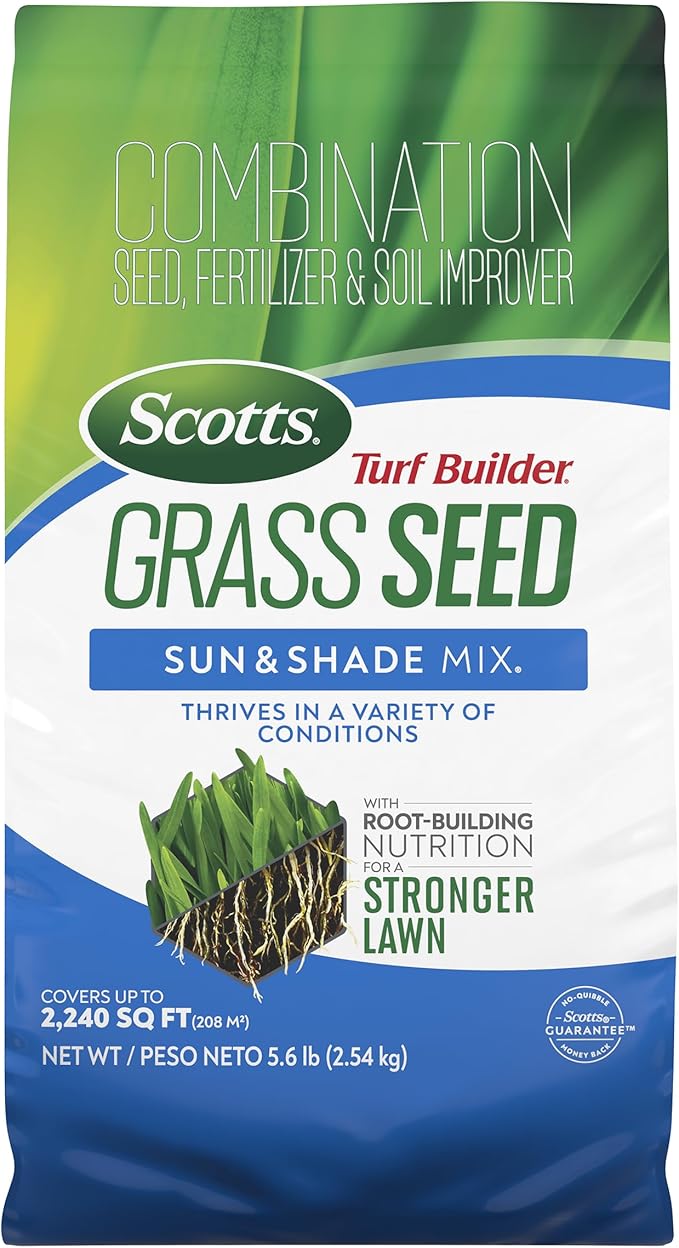
Shade areas often struggle with patchy, thin grass that refuses to grow evenly. Scotts Turf Builder Sun & Shade Grass Seed Mix suits lawns that see a mix of sun and shade. Its biggest strength lies in promoting thick, green grass by building deep roots with added nutrition.
Setting up involves spreading the seed mix evenly, ideally in spring when it’s time to plant. The combination of Kentucky bluegrass, perennial ryegrass, creeping red fescue, chewings fescue, and hard fescue adapts well to both sunny and moderately shaded spots.
The built-in fertilizer and soil improver help grass establish more easily, while regular watering is needed to keep the lawn healthy. A Scotts spreader works well to cover the area consistently.
Performance-wise, the grass grows thick and green if cared for properly, showing medium drought tolerance and good durability under moderate foot traffic. The variety of grass types helps it thrive in mixed light conditions. Most praiseworthy is how the deep root development strengthens the lawn.
Some complain that it requires regular watering to do well, especially in drier patches.
The strongest point is its ability to establish thick grass with deep roots thanks to added nutrition. Common feedback highlights the need for consistent watering to keep the turf green, especially during dry spells.
Those with lawns that receive mixed sun and shade and are willing to water regularly will appreciate this seed mix. It’s less suited for areas with severe drought or those seeking low-maintenance options.
Pros
- Works in both sun and moderate shade areas
- Includes fertilizer and soil improver for easier growth
- Mix of different grass types adapts well
- Helps develop deep roots for a stronger lawn
Cons
- Needs regular watering to maintain healthy growth
- Performance can vary in extreme drought conditions
| Specification | Details |
|---|---|
| Sunlight Exposure | Full Sun |
| Expected Planting Period | Spring |
| Medium Drought Tolerance | Yes |
| Seed Treatment Method | Scotts Spreader |
| USDA Hardiness Zone | 5 |
| Moisture Needs | Regular Watering |
8. Pennington Smart Sun and Shade Grass Seed Mix

Designed for lawns receiving 4 to 6 hours of daily sunlight, Pennington Smart Sun and Shade Grass Seed Mix is a smart choice for establishing green grass in shaded yards. Its biggest strength lies in the built-in fertilizer coating that helps grass green up faster than regular seeds.
Setup is straightforward with seed coated in fertilizer, cutting down on extra steps. Planting in spring or fall is recommended when temperatures range from 60°F to 80°F. The seed is meant for outdoor use and requires moderate watering. It’s ideal both for starting new lawns and overseeding thin patches that get a mix of sun and shade.
The grass grows to about 3 inches tall, fitting well in many home settings.
The seed mix performs well under varied light conditions, showing good drought tolerance once established, so watering can be less frequent. Its coating helps early growth, resulting in a greener lawn faster than uncoated alternatives.
The most praised feature is how it stays greener longer with moderate watering, while some users note it may not fully thrive in deeper shade areas.
The built-in fertilizer coating accelerates green-up times, keeping lawns vibrant with less effort. However, the grass seed struggles a bit in deeper shade, limiting its success to spots with moderate sunlight.
Gardeners with lawns receiving 4 to 6 hours of sunlight who want a low-maintenance, greener lawn will appreciate this mix. Those needing grass for heavy shade might consider other seed options tailored for minimal sun exposure.
Pros
- Includes fertilizer coating for faster greening
- Good drought tolerance once established
- Suitable for mixed sun and shade areas
- Works well for new lawns and overseeding
Cons
- Not ideal for areas with less than 4 hours of sun
- May require moderate watering initially
| Specification | Details |
|---|---|
| Sunlight Exposure | 4-6 Hours |
| Plant Height | 3 inches |
| Seed Treatment Method | Coated |
| Moisture Needs | Moderate Watering |
| Best Time to Plant | Spring or Fall |
9. Pennington the Rebels Tall Fescue Grass Seed

Great for homeowners dealing with shady lawns, this grass seed suits those looking for a dense, durable turf that can handle less sun and still look great. Its standout feature is the ability to grow well in partial shade while resisting tough conditions like drought and heavy foot traffic.
Planting requires about 4 to 6 hours of sunlight, making it ideal for areas that don’t get full sun all day. It needs regular watering and starts showing results within 8 to 16 days, so you can expect to see new growth fairly quickly.
Because it thrives in a wide range of soils, getting it set up usually goes smoothly without special soil prep.
Once established, the lawn is noticeably darker, greener, and denser than many other tall fescues. Its thick roots help it stand up to heat, insects, and heavy use, leading to lower maintenance overall.
Some users find the initial setup time a bit longer than they expected before full coverage happens, but the toughness and appearance make up for it.
The toughest feature of this grass is its dense, rich green coverage and ability to handle rough conditions like drought and heavy traffic. The main drawback is that even with fast initial growth, it can require patience before fully filling in and looking its best.
People with lawns that get partial sun and need a low-maintenance option will appreciate how it holds up in challenging spots. Those who need quick, full coverage or have very dry conditions might want to consider alternatives better suited for less watering or faster growth.
Pros
- Thick, deep, and dense root system
- Grows well in partial shade
- Resistant to heat, drought, and insects
- Shows growth in 8 to 16 days
Cons
- Needs regular watering to thrive
- Planting and full coverage can take some time
| Specification | Details |
|---|---|
| Sunlight Exposure | 4-6 Hours of Sun |
| Expected Blooming Period | Spring |
| Expected Plant Height | 3 inches |
| Moisture Needs | Regular Watering |
| USDA Hardiness Zone | 1-8 |
10. Jonathan Green Dense Shade Grass Seed Mixture

Designed specifically for shady spots where other seeds fail, this seed mixture stands out by thriving in low-light conditions. Ideal for yards with heavy shade, its resistance to disease and pests makes it a practical choice for those wanting a green lawn without constant maintenance.
Easy to sow on sandy soil, the seed establishes quickly thanks to a high germination rate. It’s meant for outdoor use and handles shade very well.
The fast establishment means you won’t have to wait long to see results, and its resistance to common lawn problems keeps it looking healthy with less effort.
It consistently fills in shaded areas where grass usually struggles, providing a dense cover. The mixture is built to hold up against diseases and pests, keeping your lawn intact over time. A frequent compliment is its quick growth under less-than-ideal light, while the most common downside is that it’s only suited for sandy soil, limiting its use in other soil types.
The mixture earns praise for quick growth and dense coverage in shady yards, solving a common issue with shaded lawns. Some users note challenges due to its restriction to sandy soil, limiting flexibility depending on yard conditions.
People with shady lawns and sandy soil will find this seed mixture very effective. Those dealing with other soil types or wanting a more versatile option might want to consider alternative products better suited to their needs.
Pros
- Grows well in heavy shade
- Disease and pest resistant
- Fast to establish with high germination
- Works specifically on sandy soil
Cons
- Limited to sandy soil types
- Manufactured in China may concern some buyers
| Specification | Details |
|---|---|
| Weight | 7 lb |
| Shade Resistance | Yes |
| Soil Type | Sandy Soil |
| Sunlight Exposure | Shade |
| Disease Resistance | Yes |
| Pest Resistance | Yes |
11. Pennington the Rebels Sun and Shade Grass Seed Mix

Pennington The Rebels Sun and Shade Grass Seed Mix is built for lawns that get both sun and shade. It suits gardeners wanting a tough, dense lawn that keeps its green color even in challenging spots. Its biggest strength lies in thick, deep roots that handle stress and wear better than most tall fescues.
Planting in spring with regular watering helps the lawn establish quickly, showing visible growth in as little as 8 to 21 days. It thrives on 4 to 6 hours of sunlight a day and adapts well to various soil types, making daily lawn care less demanding. The grass height maxes out at about 3 inches, which keeps mowing straightforward and manageable.
Its main job of creating a dense, green lawn in partially shaded areas is done well, standing up to drought, heat, insects, and heavy foot traffic. Reviews highlight how resilient and vibrant the grass stays through tough weather.
Some note it needs consistent watering at the start to grow well, which can be a bit of extra work in drier times.
Many appreciate how well the grass stays green and thick even in shaded conditions. A common note is the requirement for regular watering early on, which means a little extra attention at the beginning to get a strong lawn established.
Great choice for anyone with a lawn that spans sun and shade and can commit to some watering. Those with less sun or less time to water might look for grass types needing less moisture or full shade tolerance.
Pros
- Tough roots withstand heavy traffic and drought
- Darker and greener than many tall fescues
- Grows well in partial shade and diverse soils
- Rapid visible results within 8 to 21 days
Cons
- Needs regular watering to establish
- Limited to areas getting at least 4 hours sunlight
| Specification | Details |
|---|---|
| Sunlight Exposure | 4-6 Hours of Sun Per Day |
| Expected Plant Height | 3 inches |
| Expected Blooming Period | Spring to Summer |
| Moisture Needs | Regular Watering |
| Expected Planting Period | Spring |
12. Pennington Smart Seed Kentucky Bluegrass Blend

Growing grass in shaded spots usually feels like a struggle, but this Kentucky bluegrass blend makes it easier. It suits homeowners with lawns getting about 4 to 6 hours of sunlight daily and really shines in producing a thick, healthy lawn with less water. Its standout feature is the built-in fertilizer that helps grass thrive without extra fuss.
Setup involves planting the coated seeds in early spring and regular watering to keep things moist. The blend includes fertilizer right in the seed coating, meaning you don’t have to add much fertilizer later on. It’s designed to handle moderate sun and shade, fitting well for places under trees or near buildings.
Watching grass begin to sprout within 15 to 30 days is a reassuring sign.
The grass grows to about 3 inches tall and creates a dense turf that stands up well to foot traffic and disease. Its resistance makes it durable for lawns that get used frequently. Most people found the lawn stays greener longer while using less water.
Some noted that it still requires regular watering to look its best, which can be demanding in dry stretches.
The biggest praise comes from how quickly the seed starts showing results combined with its durability to traffic and diseases. Regular watering is a common necessity for keeping the lawn looking lush, which some find demanding during dry times.
Those wanting a lawn that saves water and holds up well in shaded, moderately sunny areas will appreciate this blend. People with lawns needing less frequent watering or wanting year-round planting options might want to look elsewhere.
Pros
- Includes fertilizer for easy growth support
- Resistant to disease and heavy traffic
- Uses up to 30% less water yearly
- Grows well with moderate sunlight
Cons
- Needs regular watering to stay healthy
- Best planted in spring only
| Specification | Details |
|---|---|
| Sunlight Exposure | 4-6 Hours |
| Expected Plant Height | 3 inches |
| Seed Treatment Method | Coated |
| Expected Blooming Period | Fall |
| Moisture Needs | Regular Watering |
Best Grasses for Shade Areas Comparison Table
| Product | Shade Resistance | Sunlight Exposure | Moisture Needs | USDA Hardiness Zone |
|---|---|---|---|---|
| Jonathan Green Dense Shade | Shade Resistant | Full Sun | – | – |
| Pennington Smart Seed Shade | Dense Shade | 2-6 Hours | Moderate Watering | 1-12 |
| Penn Rebels Tall Fescue | The Rebels Tall Fescue | 2-6 Hours | – | 1-8 |
| X-Seed Ultra Premium Shade | Premium | 4-7 Filtered Sunlight | Moderate Watering | 1 |
| Pennington Kentucky 31 | Kentucky 31 Tall Fescue | 4-8 Hours | – | 1-8 |
| Scotts Sun & Shade | – | Full Sun | – | – |
| Scotts Sun & Shade Mix | Medium Drought Tolerant | Full Sun | – | – |
| Pennington Smart Sun Shade | Smart Seed Sun & Shade | 4-6 Hours | Moderate Watering | 1-7 |
| Pennington Rebels Tall Fescue | The Rebels Tall Fescue | 4-6 Hours | Regular Watering | 1-8 |
| Jonathan Green Shade Mix | Shade Resistant | Shade | – | – |
| Pennington Rebels Sun Shade | The Rebels Sun & Shade | 4-6 Hours | Regular Watering | – |
| Pennington Smart Kentucky Bluegrass | Smart Seed Kentucky Bluegrass | 4-6 Hours | Regular Watering | 1,3-7 |
- Shade ResistanceShade Resistant
- Sunlight ExposureFull Sun
- Moisture Needs–
- USDA Hardiness Zone–
- Shade ResistanceDense Shade
- Sunlight Exposure2-6 Hours
- Moisture NeedsModerate Watering
- USDA Hardiness Zone1-12
- Shade ResistanceThe Rebels Tall Fescue
- Sunlight Exposure2-6 Hours
- Moisture Needs–
- USDA Hardiness Zone1-8
- Shade ResistancePremium
- Sunlight Exposure4-7 Filtered Sunlight
- Moisture NeedsModerate Watering
- USDA Hardiness Zone1
- Shade ResistanceKentucky 31 Tall Fescue
- Sunlight Exposure4-8 Hours
- Moisture Needs–
- USDA Hardiness Zone1-8
- Shade Resistance–
- Sunlight ExposureFull Sun
- Moisture Needs–
- USDA Hardiness Zone–
- Shade ResistanceMedium Drought Tolerant
- Sunlight ExposureFull Sun
- Moisture Needs–
- USDA Hardiness Zone–
- Shade ResistanceSmart Seed Sun & Shade
- Sunlight Exposure4-6 Hours
- Moisture NeedsModerate Watering
- USDA Hardiness Zone1-7
- Shade ResistanceThe Rebels Tall Fescue
- Sunlight Exposure4-6 Hours
- Moisture NeedsRegular Watering
- USDA Hardiness Zone1-8
- Shade ResistanceShade Resistant
- Sunlight ExposureShade
- Moisture Needs–
- USDA Hardiness Zone–
- Shade ResistanceThe Rebels Sun & Shade
- Sunlight Exposure4-6 Hours
- Moisture NeedsRegular Watering
- USDA Hardiness Zone–
- Shade ResistanceSmart Seed Kentucky Bluegrass
- Sunlight Exposure4-6 Hours
- Moisture NeedsRegular Watering
- USDA Hardiness Zone1,3-7
How to Choose the Best Grass for Shade
Selecting grass that thrives in low light, resists disease, and matches your soil type is essential for shaded areas. Choosing the right variety ensures healthier growth, reduces maintenance, and prevents costly reseeding or damage, saving time and money in the long run.
Shade Tolerance
Grass growing under thick tree canopy often struggles with low light, creating thin, patchy areas that require constant repair. Choosing grass with strong shade tolerance means it stays green and healthy even when sunlight is sparse. I’ve seen common lawn grasses fade quickly in heavy shade, leading to bare spots full of weeds or moss.
Good shade-loving varieties resist diseases like powdery mildew and red thread, which thrive in shaded, damp conditions. Some adapt well to dense tree cover, while others prefer the dappled light of partial shade.
It’s important to match the grass type to your specific shade situation to avoid constant reseeding or disease treatments.
Growth Rate and Density
Establishing a grassy lawn in shaded patches can feel like watching paint dry if you pick a slow-growing type. Grasses with a quicker growth rate fill in bare spots faster, giving better initial coverage and suppressing weeds early on.
Dense turf also makes a noticeable difference in how full the lawn looks and how much foot traffic it can take.
Growth habits influence maintenance: denser, fast-growers might need more frequent mowing, while sparse grasses often require additional overseeding. From my experience, grasses that reach a density rating around medium to high strike the best balance for shaded areas, keeping upkeep manageable without sacrificing looks.
Soil and Moisture Adaptability
Shade often comes with uneven soil conditions, from dry, compacted earth to moist, loamy patches. Grass that adapts well to a range of soil types avoids thin, weak lawns prone to disease.
Some like looser, well-drained soil, while others handle clay or sandy soils better.
Watering is tricky in shade; too much moisture encourages fungal issues, yet drought-intolerant grass can brown quickly during dry spells. Good choices tolerate moderate drought and don’t demand daily watering.
Resistance to fungal problems common in shaded, moist areas is essential, lawns with poor resistance often end up patchy and unsightly.
Wear and Traffic Tolerance
Shaded lawns often serve as play areas or footpaths, so grass needs to handle regular wear and tear without turning to mud. Types with strong durability and a fast recovery rate bounce back after heavy use, preventing permanent damage or soil compaction.
Grass that stands up to pets and children needs a balanced toughness; overly delicate varieties thin out too fast, while very coarse types might be uncomfortable. Look for a grass that maintains coverage after frequent traffic and regrows quickly enough to keep the lawn looking even.
Aesthetic Qualities
The darker, cooler conditions under shade can dull grass color and affect texture. Grasses with naturally rich green tones and fine blades make shaded areas appear more vibrant and inviting rather than dull or patchy.
Seasonal changes also impact appearance. Some grasses lose color or thin out in colder months, while others retain a consistent look year-round. Matching grass to existing landscaping, such as trees or shrubs, ensures a uniform, cohesive appearance without stark contrasts in texture or shade adaptation.
Tips for Establishing and Growing Grass in Shaded Areas
Grass growing under shade needs less frequent watering but benefits from deeper, occasional watering sessions to encourage strong root growth. Avoid planting thick, dense grass varieties in heavily shaded spots since they might struggle to get enough light.
Instead, focus on grass species known for tolerance to low light such as fine fescues or St. Augustine grass, which handle shade better and stay healthier.
Soil preparation plays a key role in establishing grass in shade. Aerate the soil first to reduce compaction from tree roots or surrounding plants.
Adding organic matter also helps retain moisture without creating waterlogged conditions. Maintain a slightly higher mowing height as this encourages the grass to capture more sunlight and develop deeper roots.
- Choose shade-tolerant grass varieties suited to your region
- Increase watering depth but reduce frequency
- Prepare soil by aerating and adding organic matter
- Raise mowing height to improve sunlight absorption
Common Mistakes to Avoid When Maintaining Shade-Tolerant Lawns
One common mistake is overwatering shaded grass, which can cause fungal diseases and poor root development. Since less sunlight hits these areas, moisture stays longer and roots get less oxygen. Grass also suffers from infrequent mowing.
Mowing too rarely allows the grass to grow too long, which shades the lower leaves and stresses the plant.
Using a fertilizer with excessive nitrogen is another issue. This promotes quick leafy growth that gets weak under shade and demands more water, stressing the lawn further.
Another problem is ignoring soil health, dense, compacted soil limits root expansion and nutrient uptake. Regular soil testing helps guide fertilizer and amendment choices.
- Do not overwater shaded lawns
- Mow regularly to avoid overgrown grass
- Avoid high nitrogen fertilizers in shaded areas
- Monitor and maintain good soil conditions
Comparing Shade-Tolerant Grass Alternatives for Different Climate Zones
Cool-season grasses like fine fescue thrive in shaded areas of northern climates where summers are milder. They stay green longer and tolerate less sunlight better than many other species. Southern regions benefit more from warm-season grasses like St.
Augustine or Zoysia, which manage heat and moderate shade well.
Kentucky bluegrass performs well in partial shade but requires more sunlight than fine fescue, making it less suitable for dense shade. Bermuda grass prefers full sun but some varieties handle light shade better in warmer zones.
Each type demands different watering and mowing practices, so check local recommendations.
- Fine fescue suits northern cooler climates in shade
- St. Augustine and Zoysia perform well in southern warm areas
- Kentucky bluegrass prefers partial shade, not dense shade
- Bermuda grass mainly thrives in sun but some tolerate light shade
People Also Asked
How Do You Care for Grass Planted in Shaded Areas?
Grass in shaded areas needs less water than in full sun but should be watered early in the day to avoid fungal issues. Mowing less frequently and leaving the grass a bit longer helps it gather more light. Aerating in spring can improve soil health and root growth.
What Size Grass Patch Is Ideal for Small Shaded Yards?
A patch about 5 to 10 square feet works well for small shaded yards, allowing enough space for the grass to establish without overwhelming the area. This size also makes it easier to maintain and manage moisture levels without drowning the plants.
Is Grass for Shade Safe Around Children and Pets?
Grass suited for shade is generally safe around children and pets, assuming no chemical treatments are applied. Choosing organic fertilizers and avoiding pesticides will keep the area safer and more inviting for families and animals.
How Long Does Grass in Shaded Areas Typically Last?
Grass in shaded areas can last many years with proper care, usually similar to sunny lawns if kept healthy and free from disease. Regular cleanup of debris and monitoring moisture levels helps prevent rot and decay that shorten grass lifespan.
What Are Common Problems with Grass Growing in Shade?
Common problems include thin growth, moss invasion, and fungal diseases due to moisture and lack of sunlight. Compacted soil and poor air circulation also create challenges, so aerating and trimming overhanging branches often improve turf health.
Conclusion
Choosing the right grass for shade means focusing on tolerance to low light, durability under foot traffic, and the ability to stay green with less sun. These factors affect how well the grass will grow and how much maintenance it will need in your shaded spot.
Think about how much space you have and how often you plan to use the area before making a decision. A larger area or frequent use might require more resilient grass. The comparison table and earlier sections can help you weigh these points against your needs and budget.

I’m Jake Thompson, and I’ve spent over a decade working on lawn mowers, from small push mowers to big riding tractors. I write about starting problems, blade sharpening, carburetor cleaning, oil changes, and seasonal maintenance. My goal is to give you clear, step-by-step advice so you can handle common mower issues yourself and keep your lawn looking sharp all season.